In this article
- What are demographic survey questions?
- When to ask demographic questions
- Age questions
- Gender questions
- Education level questions
- Employment and occupation questions
- Income questions
- Location questions
- Household and family questions
- Race, ethnicity and language questions
- Business and job role questions
- How to ask demographic questions well
- Mistakes to avoid
- Privacy and sensitive data
- How to analyze demographic data
- Building demographic questions in FormitAI
- Frequently asked questions
What are demographic survey questions?
Demographic survey questions ask about who the respondent is: their age, gender, education, job, income, location, household and similar characteristics. On their own they rarely answer your research question. Their value is in comparison. If 60% of all customers are satisfied, the demographic questions tell you whether that is 80% of one age group and 40% of another, which is often the more useful finding.
When to ask demographic questions
There are three good reasons to include them. If none applies, leave them out.
- To compare groups: you plan to report results by age, region, role or another trait
- To check who answered: you want to see whether your respondents resemble the population you care about
- To screen respondents: the survey is only for a certain group, so you ask the qualifying question first
Age questions
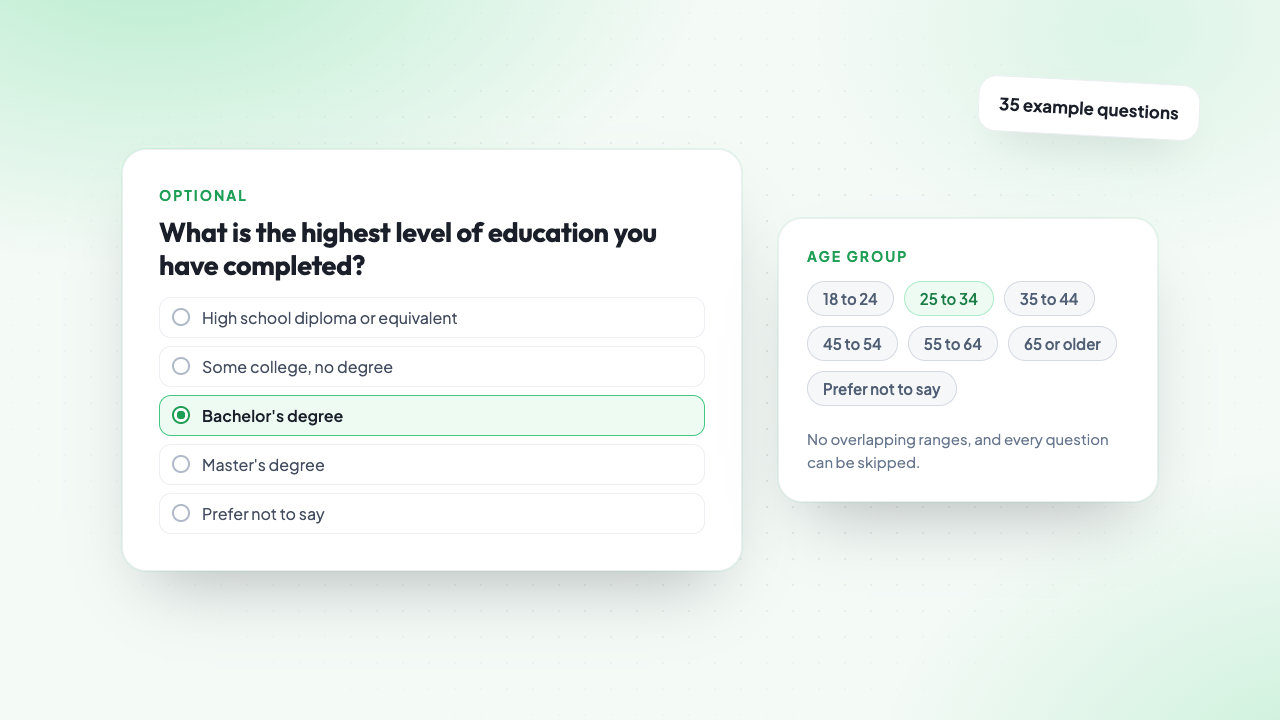
Ask for an age range rather than an exact age or date of birth, unless you need the precise number. Ranges feel less personal and are easier to analyze. Make sure the ranges do not overlap.
- What is your age? (Under 18 / 18 to 24 / 25 to 34 / 35 to 44 / 45 to 54 / 55 to 64 / 65 or older / Prefer not to say)
- In what year were you born? (use only if you need exact age, for example in health research)
- Are you 18 or older? (Yes / No), as a screening question
Gender questions
Keep the options inclusive and let people describe themselves. Ask about gender, not sex, unless sex at birth is relevant to your research, such as in some medical studies.
- What is your gender? (Woman / Man / Non-binary / Prefer to self-describe: ___ / Prefer not to say)
- Do you identify as transgender? (Yes / No / Prefer not to say), only when your research needs it
Education level questions
The standard education level survey question asks for the highest level completed, so that each person fits exactly one option. Match the options to the country you are surveying, because education systems differ. A common United States version is below, followed by a shorter version and other education questions.
- What is the highest level of education you have completed? (Less than high school / High school diploma or equivalent / Some college, no degree / Associate degree / Bachelor's degree / Master's degree / Professional degree, such as MD or JD / Doctorate / Prefer not to say)
- Short version: What is the highest level of education you have completed? (Secondary school or less / Some college or vocational training / Bachelor's degree / Postgraduate degree / Prefer not to say)
- Are you currently enrolled in school or college? (Yes, full-time / Yes, part-time / No)
- What was your main field of study?
Employment and occupation questions
Employment status questions often need a "select all that apply" format, because a person can be a student and work part-time.
- What is your current employment status? Select all that apply. (Employed full-time / Employed part-time / Self-employed / Unemployed and looking for work / Student / Retired / Unable to work / Homemaker or caregiver / Prefer not to say)
- Which of the following best describes your occupation? (Management / Professional / Sales / Office and administrative / Service / Skilled trade / Other)
- How many hours do you work in a typical week?
Income questions
Income is one of the most sensitive questions, and many people skip it. Ask for a range, say whether you mean individual or household income and before or after tax, and always offer "Prefer not to say".
- What was your total household income before taxes last year? (Under $25,000 / $25,000 to $49,999 / $50,000 to $74,999 / $75,000 to $99,999 / $100,000 to $149,999 / $150,000 or more / Prefer not to say)
- Which of these best describes your household's financial situation? (Living comfortably / Getting by / Finding it difficult / Prefer not to say)
Location questions
Ask at the level of detail you will analyze. A country is enough for most international surveys; a region or postal code suits local research.
- Which country do you live in?
- Which state or region do you live in?
- How would you describe the area where you live? (Urban / Suburban / Rural)
- What is your postal code? (only if you need local detail)
Household and family questions
These help in consumer, housing and public-sector research. Ask only the ones that relate to your topic.
- What is your marital status? (Single, never married / Married or in a civil partnership / Living with a partner / Separated / Divorced / Widowed / Prefer not to say)
- How many people live in your household, including you?
- Do you have children under 18 living with you? (Yes / No / Prefer not to say)
- Do you own or rent your home? (Own / Rent / Live with family / Other)
Race, ethnicity and language questions
Let people choose more than one option, and follow the categories your national statistics office uses if you want to compare with census data. Many surveys ask about ethnicity and race as two separate questions.
- Which of the following best describes your race or ethnicity? Select all that apply.
- Are you of Hispanic, Latino or Spanish origin? (Yes / No / Prefer not to say)
- What language do you mainly speak at home?
Business and job role questions
In business-to-business surveys, the useful "demographics" are about the respondent's company and role. These are often called firmographics.
- How many people work at your company? (1 to 10 / 11 to 50 / 51 to 200 / 201 to 1,000 / More than 1,000)
- Which industry does your company work in?
- Which department do you work in? (Sales / Marketing / Product / Engineering / Operations / Finance / HR / Other)
- What is your level of seniority? (Individual contributor / Manager / Director / Vice president or above / Owner or founder)
- Are you involved in choosing software for your team? (I make the decision / I influence the decision / I am not involved)
How to ask demographic questions well
Demographic questions are easy to write badly. These rules keep the data clean and respondents comfortable.
- Ask only for what you will analyze. Every extra personal question increases drop-off.
- Put them at the end, unless you need one to screen respondents at the start. People are more willing to share once they have finished the main questions.
- Say why you are asking, in one line, such as "These help us compare answers between groups."
- Make them optional and add "Prefer not to say" to every sensitive question.
- Make options exhaustive and non-overlapping: 18 to 24 and 25 to 34, not 18 to 25 and 25 to 35.
- Use "select all that apply" where several answers can be true, such as race or employment status.
- Reuse standard categories, such as census groupings, if you want to compare with other data.
Mistakes to avoid
These problems either lose you respondents or leave you with data you cannot use.
- Asking for exact income or date of birth when a range would do
- Missing options, which force people into a category that does not fit
- Out-of-date or narrow gender and family options that alienate respondents
- Making demographic questions required, which leads to drop-off or false answers
- Collecting personal data you have no plan to analyze, which adds privacy risk for no benefit
Privacy and sensitive data
Some demographic data, such as race, health, religion or sexual orientation, counts as special category data under laws like the GDPR and needs extra care. Collect it only with a clear purpose, tell people how it will be used, and limit who can see individual responses. Wherever you can, report results for groups rather than individuals, and avoid reporting groups so small that a person could be identified.
How to analyze demographic data
Demographic answers are used to split your other results. The basic tool is a cross-tabulation: a table showing how each group answered a question.
- Check the sample first: compare who answered with the population you care about
- Cross-tabulate key questions by one demographic at a time, such as satisfaction by age group
- Watch group sizes. A group of 12 respondents gives an unstable percentage; combine small groups or report them with care.
- Treat differences as clues, then check them with a larger sample or a statistical test before acting
- If your sample is far from the population, weighting can adjust for it; this is common in market and social research
Building demographic questions in FormitAI
Use a Multiple Choice block for questions with one answer, such as age group or education level, and add "Prefer not to say" as one of the options. Use Multi-Select for "select all that apply" questions such as employment status or ethnicity, and a Dropdown block for long lists such as country or state. Leave these questions optional rather than turning on Required. If you need a screening question, put it first and add a rule in the Logic tab that sends people who do not qualify to an ending. To compare groups, export responses to CSV or send them to Google Sheets and build your cross-tabs there. You can also control who in your workspace can see responses.
Frequently asked questions
- What are examples of demographic survey questions?
- Common examples are "What is your age?", "What is your gender?", "What is the highest level of education you have completed?", "What is your current employment status?", "What was your household income last year?" and "Which country do you live in?", each with a set of answer options and "Prefer not to say".
- How do you ask about education level in a survey?
- Ask "What is the highest level of education you have completed?" with options that match the country you are surveying. A common US list is less than high school, high school diploma or equivalent, some college with no degree, associate degree, bachelor's degree, master's degree, professional degree, doctorate, and prefer not to say.
- Should demographic questions go at the beginning or end of a survey?
- At the end, in most cases. Respondents are more willing to share personal details after they have answered the main questions. The exception is a screening question that decides whether someone should take the survey at all; that goes first.
- Should demographic questions be required?
- No. Make them optional and offer "Prefer not to say". Required personal questions increase drop-off and push some people to give false answers.
- What are the 5 main demographic variables?
- Age, gender, education, income and location are the five most commonly used. Employment status, household composition and ethnicity are also widely used, depending on the research topic.
Written by
FormitAI Team
We build FormitAI, an AI form builder that drafts forms from a prompt and asks follow-up questions based on each answer. Our guides come from building and testing forms and surveys every day.
About FormitAIBuild your next form in FormitAI
Describe the form you need and get an editable draft, then let AI follow-ups ask respondents the question you would have asked in person. Free to start.