In this article
- The 10 types of survey questions
- Multiple choice question examples
- Checkbox question examples
- Rating scale question examples
- Likert scale question examples
- Ranking question examples
- Matrix question examples
- Open-ended question examples
- Yes or no question examples
- Demographic question examples
- Net Promoter Score question examples
- How to choose the right question type
- Five mistakes that spoil survey questions
- Building these question types in FormitAI
- Frequently asked questions
The 10 types of survey questions
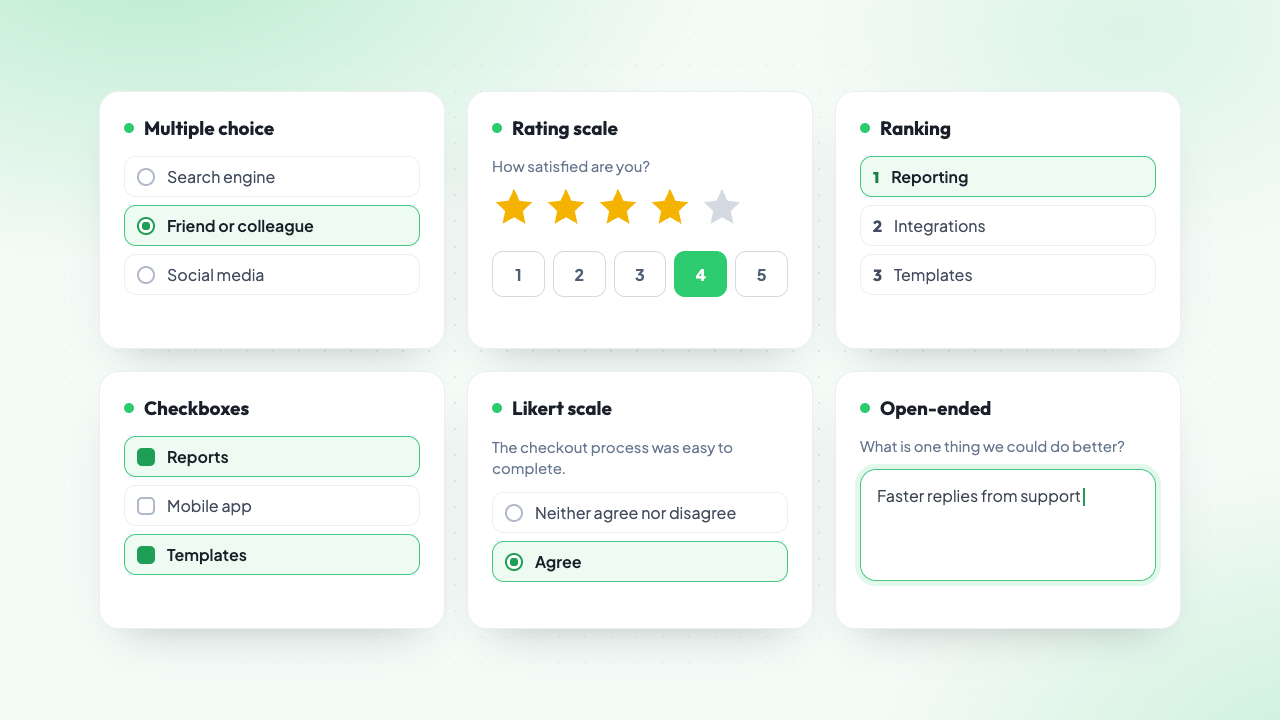
Almost every survey question is one of ten types. The type decides what kind of data you get back, so choose it before you write the wording. This guide gives five example questions for each type, with a note on when to use it.
- Multiple choice (single answer): pick one option from a list
- Checkbox (multiple answer): pick every option that applies
- Rating scale: a number or star score
- Likert scale: level of agreement with a statement
- Ranking: put options in order of preference
- Matrix: several items rated on the same scale
- Open-ended: a typed answer in the respondent's own words
- Yes or no (dichotomous): two possible answers
- Demographic: facts about the respondent
- Net Promoter Score: likelihood to recommend, from 0 to 10
Multiple choice question examples
Use single-answer multiple choice when the options do not overlap and one of them will fit everyone. Add an "Other" option if you are not sure your list is complete.
- How did you first hear about us? (Search engine / Social media / Friend or colleague / Advertisement / Other)
- How often do you use our product? (Daily / Weekly / Monthly / Less than once a month)
- Which plan are you on? (Free / Pro / Business / Not sure)
- What is your main reason for visiting today? (Buy something / Compare prices / Get support / Just browsing)
- Which device do you use most for work? (Laptop / Desktop / Tablet / Phone)
Checkbox question examples
Use checkboxes when more than one answer can be true. Say "select all that apply" in the question so people know they are not limited to one.
- Which of these features do you use? Select all that apply. (Reports / Integrations / Templates / Mobile app)
- Which social networks do you use at least weekly? Select all that apply.
- What did you buy from us in the last 12 months? Select all that apply.
- Which of these topics would you like to hear more about? Select all that apply.
- What stopped you from finishing your order? Select all that apply. (Price / Shipping cost / Payment options / Needed more information)
Rating scale question examples
A rating scale asks for a score on a numbered or star scale. Label both ends so everyone reads the scale the same way, and use the same scale throughout the survey.
- How satisfied are you with your recent purchase? (1 = very dissatisfied, 5 = very satisfied)
- How easy was it to find what you were looking for? (1 = very difficult, 7 = very easy)
- How would you rate the quality of support you received? (1 to 5 stars)
- How would you rate the value for money of this product? (1 = very poor, 5 = excellent)
- How likely are you to buy from us again? (1 = not at all likely, 5 = extremely likely)
Likert scale question examples
A Likert question presents a statement and asks how much the respondent agrees. The usual five points are strongly disagree, disagree, neither agree nor disagree, agree, and strongly agree. Write each statement about one idea only.
- The checkout process was easy to complete.
- I have the tools I need to do my job well.
- The product does what I expected it to do.
- My manager gives me useful feedback.
- I would feel comfortable recommending this course to a colleague.
Ranking question examples
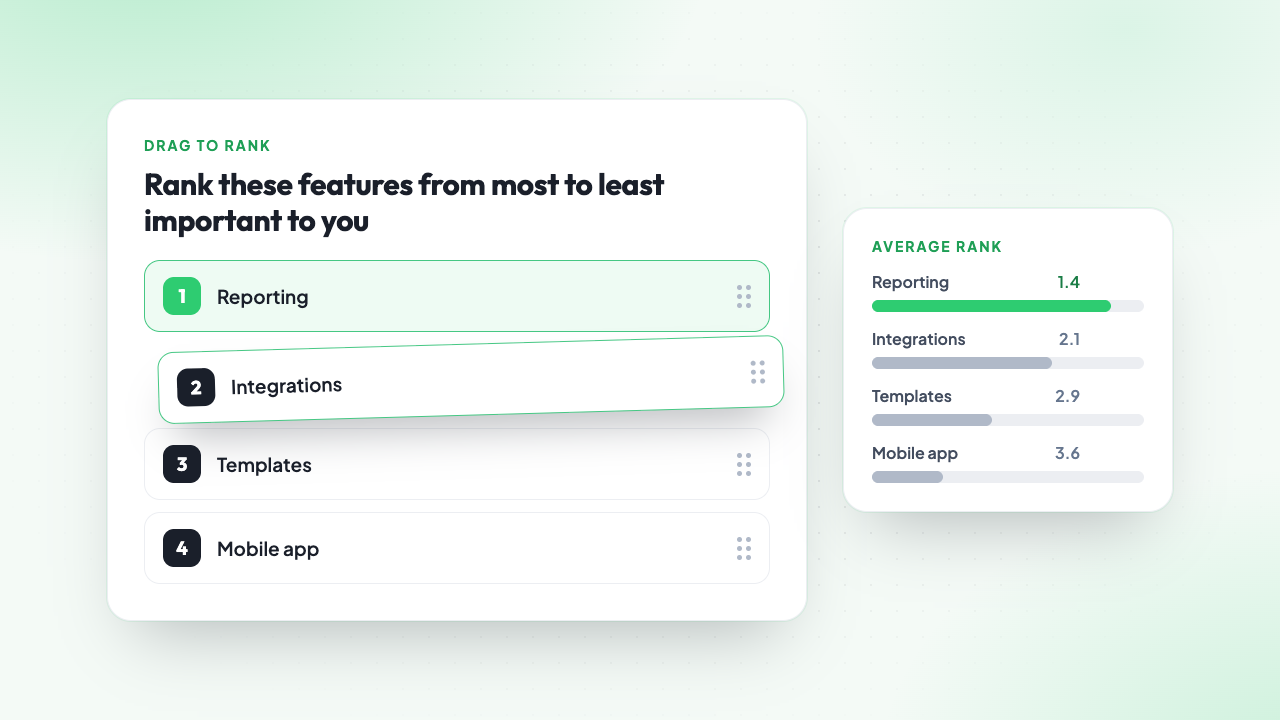
Ranking forces a choice between options, which is useful when a rating question would let people call everything important. Keep the list to about five to seven items.
- Rank these features from most to least important to you: reporting, integrations, templates, mobile app, team permissions.
- Rank these factors by how much they affect your choice of supplier: price, delivery time, quality, customer service.
- Put these benefits in order of value to you: health cover, flexible hours, remote work, training budget, extra leave.
- Rank these session topics from most to least interesting.
- Order these improvements by which we should work on first.
Matrix question examples
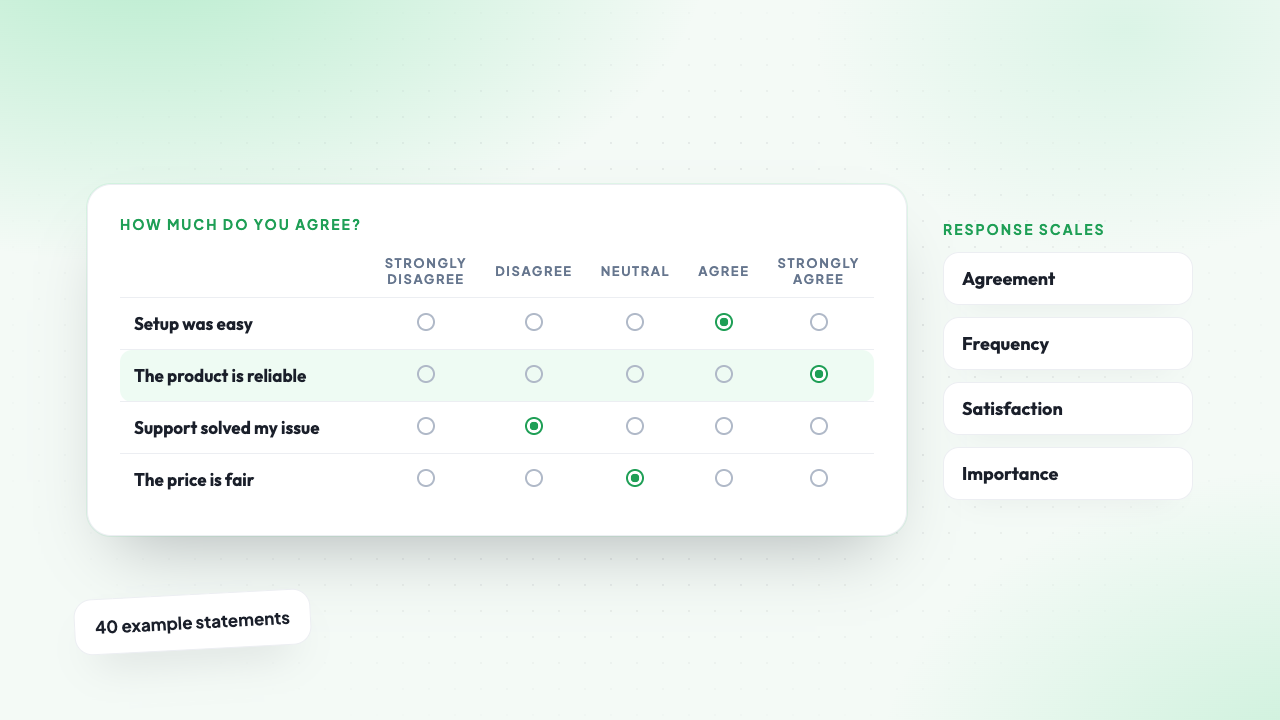
A matrix (or grid) question rates several items on one shared scale. It saves space, but large grids are tiring and hard to use on a phone. Keep it to around five rows.
- How satisfied are you with each of the following? Rows: speed, reliability, design, support. Columns: very dissatisfied to very satisfied.
- How often do you use each of these channels to contact us? Rows: email, phone, live chat, social media. Columns: never, rarely, sometimes, often.
- How important is each of these when choosing a hotel? Rows: price, location, cleanliness, breakfast. Columns: not important to very important.
- How much do you agree with each statement about your team? Rows: we communicate well, we meet deadlines, we share knowledge. Columns: strongly disagree to strongly agree.
- How would you rate each part of the event? Rows: speakers, venue, catering, networking. Columns: poor, fair, good, excellent.
Open-ended question examples
Open-ended questions collect a typed answer. Use them for reasons and ideas you cannot predict, and limit them to a few per survey because they take the most effort to answer.
- What is the main reason for your score?
- What is one thing we could do better?
- What were you hoping to find today that you could not?
- How would you describe our product to a friend?
- Is there anything else you would like to tell us?
Yes or no question examples
A dichotomous question has exactly two answers. It is the quickest type to answer and works well as a screening question that decides which questions come next.
- Have you bought from us before?
- Did you find what you were looking for today?
- Was your issue resolved on the first contact?
- Are you the person who makes purchasing decisions for your team?
- Would you like us to contact you about your feedback?
Demographic question examples
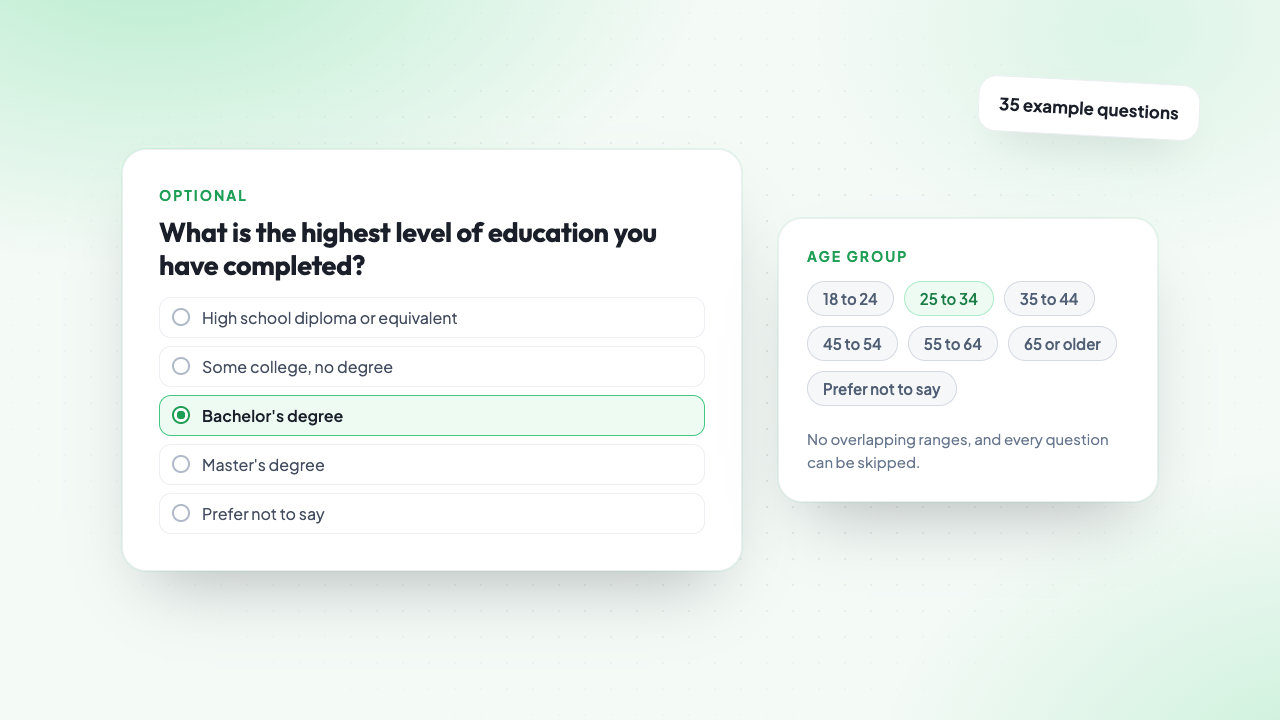
Demographic questions let you compare answers between groups. Ask only for what you will use, offer "Prefer not to say", and put these questions at the end unless you need them to screen respondents.
- What is your age group? (18 to 24 / 25 to 34 / 35 to 44 / 45 to 54 / 55 to 64 / 65 or older / Prefer not to say)
- What is the highest level of education you have completed?
- What is your current employment status?
- How many people work at your company? (1 to 10 / 11 to 50 / 51 to 200 / 201 to 1,000 / More than 1,000)
- Which country do you live in?
Net Promoter Score question examples
The Net Promoter Score question asks how likely someone is to recommend you, on a scale from 0 to 10. Keep the wording and the 0 to 10 scale unchanged so your score is comparable over time, and follow it with an open-ended "why".
- How likely are you to recommend us to a friend or colleague? (0 = not at all likely, 10 = extremely likely)
- How likely are you to recommend this product to someone with similar needs?
- Based on your recent support experience, how likely are you to recommend us?
- How likely are you to recommend working here to a friend? (the employee version, often called eNPS)
- What is the main reason for your score? (the open-ended follow-up)
How to choose the right question type
Start from what you will do with the answer, then pick the type that produces it.
- You want to count how common each answer is: multiple choice or checkbox
- You want to track a score over time: rating scale or Net Promoter Score
- You want to measure attitudes toward statements: Likert scale
- You want to know what matters most: ranking
- You want to rate several items the same way: matrix
- You want reasons, ideas, or wording: open-ended
- You want to route or screen respondents: yes or no
- You want to compare groups: demographic
Five mistakes that spoil survey questions
The question type can be right and the question can still give you bad data. These are the most common wording problems.
- Double-barreled questions: "How satisfied are you with our price and quality?" asks two things and allows one answer
- Leading questions: "How great was our service?" pushes people toward a positive answer
- Overlapping options: age ranges such as 18 to 25 and 25 to 35 leave a 25-year-old with two choices
- Missing options: no "Other", "None", or "Not applicable" forces a false answer
- Jargon: internal product names and abbreviations that respondents do not use
Building these question types in FormitAI
Each type above maps to a block in the FormitAI builder: Multiple Choice for single answers, Multi-Select for checkboxes, Scale and Star Rating for rating and Net Promoter Score questions, Ranked Option for ranking, Matrix Choice for grids, Long Text for open-ended answers, and Yes/No for dichotomous questions. You can add blocks by hand, start from a template, or describe the survey in a sentence and let the AI form generator draft it for you to edit.
Frequently asked questions
- What are the main types of survey questions?
- The ten most common are multiple choice, checkbox, rating scale, Likert scale, ranking, matrix, open-ended, yes or no (dichotomous), demographic, and Net Promoter Score. The first six and the yes or no type are closed-ended; open-ended questions collect typed answers.
- What is a good survey question?
- A good survey question asks about one thing, uses plain words, does not push the respondent toward an answer, and offers options that cover every case without overlapping.
- How many questions should a survey have?
- As few as will answer your research question. Completion falls as surveys get longer, so cut any question whose answer would not change a decision. Many feedback surveys work well with five to ten questions.
- What is the difference between a rating scale and a Likert scale?
- A Likert scale is one kind of rating scale. It measures agreement with a statement, usually from strongly disagree to strongly agree. Other rating scales measure things like satisfaction, ease, or likelihood with a number or star score.
Written by
FormitAI Team
We build FormitAI, an AI form builder that drafts forms from a prompt and asks follow-up questions based on each answer. Our guides come from building and testing forms and surveys every day.
About FormitAIBuild your next form in FormitAI
Describe the form you need and get an editable draft, then let AI follow-ups ask respondents the question you would have asked in person. Free to start.