In this article
- What is a Likert scale question?
- Likert item vs Likert scale
- Common Likert response scales
- 5-point or 7-point?
- Should you include a neutral option?
- Customer satisfaction examples
- Product and usability examples
- Employee engagement examples
- Training and workshop examples
- Course evaluation examples
- Healthcare and patient experience examples
- Event feedback examples
- Brand and market research examples
- How to write a good Likert statement
- Mistakes that weaken Likert data
- Positive and negative statements
- How to analyze Likert scale data
- Building Likert questions in FormitAI
- Frequently asked questions
What is a Likert scale question?
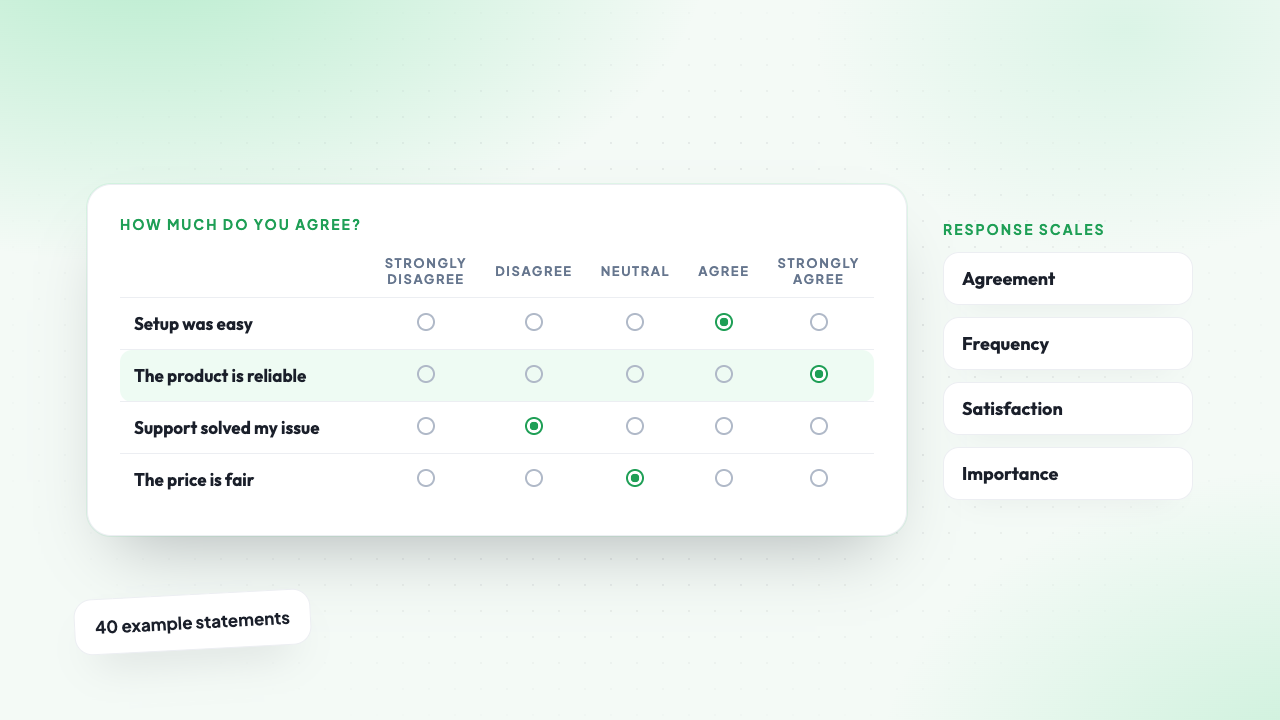
A Likert scale question presents a statement and asks the respondent to choose how much they agree with it, from strongly disagree to strongly agree. It is named after the psychologist Rensis Likert, who published the method in 1932. "The checkout process was easy to complete" with five agreement options is a typical example. Likert questions measure attitudes and opinions in a way you can count and compare, which is why they appear in almost every customer, employee and academic survey.
Likert item vs Likert scale
Strictly, one statement with its answer options is a Likert item. A Likert scale is a set of several items that measure the same idea, such as five statements about job satisfaction, whose answers are combined into one score. In everyday use people call a single item a Likert question, and that is fine. The difference matters when you analyze the results: a combined scale score from several items is more reliable than any one item on its own.
Common Likert response scales
Agreement is the classic scale, but the same format works for other dimensions. Pick the scale that matches how the statement or question is phrased.
- Agreement: strongly disagree, disagree, neither agree nor disagree, agree, strongly agree
- Frequency: never, rarely, sometimes, often, always
- Satisfaction: very dissatisfied, dissatisfied, neither satisfied nor dissatisfied, satisfied, very satisfied
- Importance: not at all important, slightly important, moderately important, very important, extremely important
- Likelihood: very unlikely, unlikely, neither likely nor unlikely, likely, very likely
- Quality: very poor, poor, fair, good, excellent
5-point or 7-point?
Five points is the default and the easiest to answer, especially on a phone. Seven points gives a little more detail and suits respondents who think carefully about their answer, such as in academic research. Beyond seven, people struggle to tell neighboring options apart and the extra detail is mostly noise. Whatever you choose, use the same number of points for every Likert item in the survey, so results are comparable.
Should you include a neutral option?
A midpoint such as "neither agree nor disagree" lets people who genuinely have no opinion say so. Remove it and you force them to pick a side, which adds false precision. Most surveys should keep the midpoint. The exception is when a decision depends on knowing which way people lean, and even then it is better to keep the midpoint and add a separate "not applicable" option for people who have no experience of the topic. Do not use the midpoint as the "not applicable" answer; they mean different things.
Customer satisfaction examples
Use these after a purchase, delivery or support conversation. Each statement is about one part of the experience.
- The product arrived when I expected it to.
- The support agent understood my problem.
- My issue was resolved on the first contact.
- The price I paid was fair for what I received.
- I would buy from this company again.
Product and usability examples
These suit in-app surveys and usability tests. Ask them right after the person has used the feature, while the experience is fresh.
- I found it easy to set up my account.
- I could find the feature I needed without help.
- The product does what I need it to do.
- The product is reliable.
- I feel confident using the product without asking for help.
Employee engagement examples
Engagement surveys are often built from sets of Likert items about the same theme. Promise anonymity only if you can deliver it.
- I know what is expected of me at work.
- I have the tools and resources I need to do my job well.
- My manager gives me useful feedback.
- I see a path for my career growth here.
- I would recommend this company as a good place to work.
Training and workshop examples
For training feedback, include at least one statement about what the person can now do, not only whether they enjoyed it.
- The objectives of the training were clear.
- The trainer explained the material clearly.
- The pace of the session was right for me.
- I can apply what I learned in my job.
- The time I spent on this training was worthwhile.
Course evaluation examples
These suit end-of-term course evaluations for schools, colleges and online courses.
- The course materials helped me learn.
- The assessments matched what was taught.
- The instructor was available when I needed help.
- I received feedback on my work in time to use it.
- This course increased my interest in the subject.
Healthcare and patient experience examples
Keep patient statements short and in plain language. Many patients complete these on a phone in a waiting room or at home.
- It was easy to book my appointment.
- I was seen at my appointment time.
- The staff treated me with respect.
- The doctor explained my treatment in a way I could understand.
- I know what to do next after my visit.
Event feedback examples
Send these within a day or two of the event. A frequency or quality scale can replace agreement for some items.
- The event was well organized.
- The sessions were relevant to my work.
- I had enough opportunities to meet other attendees.
- The venue was easy to get to.
- I plan to attend this event again.
Brand and market research examples
Use these to measure how people see a brand or a category. Show the same statements for several brands to compare them.
- This brand is one I trust.
- This brand offers good value for money.
- This brand understands people like me.
- I would consider this brand for my next purchase.
- I prefer to buy from brands that share my values.
How to write a good Likert statement
Most problems with Likert data come from the statement, not the scale. Check each statement against these rules.
- One idea per statement. "The staff were friendly and knowledgeable" cannot be answered if they were friendly but not knowledgeable.
- Write statements, not questions. "Was the app easy to use?" with agreement options reads oddly; "The app was easy to use" does not.
- Avoid absolutes such as always and never, which push people toward disagreeing.
- Avoid negatives, and never use double negatives. "I am not unhappy with the service" is hard to agree or disagree with.
- Keep statements short and specific to a real experience the respondent has had.
- Label every point on the scale, not only the ends, so everyone reads it the same way.
Mistakes that weaken Likert data
These are the errors that make results hard to trust or impossible to compare.
- Unbalanced scales, such as poor, good, very good, excellent, which has three positive options and one negative
- Changing the number of points or the order of labels partway through the survey
- Long grids of 15 or more statements, which lead people to give the same answer to every row
- Statements about things the respondent has not experienced, with no "not applicable" option
- Leading wording, such as "The helpful staff answered my questions"
Positive and negative statements
Some researchers mix positive statements with negatively worded ones, such as "I often feel stressed at work", to catch people who agree with everything. This is called reverse coding. It can help in long academic scales, but it also confuses careful respondents, and negative statements are easy to misread. For short business surveys, keep statements positive and use a "not applicable" option and a sensible length to protect data quality instead. If you do use reverse-coded items, flip their scores before you combine them.
How to analyze Likert scale data
Likert answers are ordinal: the options have an order, but the gap between "agree" and "strongly agree" is not guaranteed to equal the gap between "neutral" and "agree". That shapes how you should summarize them.
- Show the full distribution: the percentage choosing each option, often as a stacked bar
- Report the top-two box: the share choosing agree or strongly agree. It is easy to explain and to track over time.
- Use the median or mode for a single item, rather than the mean
- For a Likert scale made of several items, add or average the item scores into one scale score per respondent; that combined score can be treated more like a number
- Compare groups, such as new and long-term customers, on the same items
- Pair the scores with an open-ended question so you know why people disagreed
Building Likert questions in FormitAI
FormitAI does not have a separate Likert block, because three existing blocks cover the format. Matrix Choice is the closest fit for a set of statements: each statement is a row, the agreement options are shared columns, and the respondent picks one answer per row. For a single statement where you want every point labelled, use a Multiple Choice block with the five agreement options. If you want a compact numbered scale instead, use a Scale block, set Min value to 1 and Max value to 5, turn on Show labels, and enter Strongly disagree and Strongly agree as the Min label and Max label. Keep grids to about five rows so they stay usable on a phone, and add a Long Text question after a low-scoring section to ask for the reason.
Frequently asked questions
- What is an example of a Likert scale question?
- "The checkout process was easy to complete", answered on a scale of strongly disagree, disagree, neither agree nor disagree, agree and strongly agree. The respondent chooses how much they agree with the statement.
- What are the 5 points of a Likert scale?
- The standard agreement version is strongly disagree, disagree, neither agree nor disagree, agree and strongly agree. Other 5-point Likert-type scales measure frequency (never to always), satisfaction, importance or likelihood.
- Is a Likert scale qualitative or quantitative?
- Quantitative. The answers are ordinal data: they have a set order and can be counted and compared. They measure opinions, which is why people sometimes call them qualitative, but the data itself is numeric.
- Can you take the average of Likert scale answers?
- For a single item, the median and the share who agree are safer summaries, because the gaps between options are not guaranteed to be equal. For a scale made of several items combined into one score, averaging is common practice.
- What is the difference between a Likert scale and a rating scale?
- A Likert scale is a type of rating scale that measures agreement with a statement using labelled options. Other rating scales ask for a score directly, such as 1 to 10 or one to five stars.
Written by
FormitAI Team
We build FormitAI, an AI form builder that drafts forms from a prompt and asks follow-up questions based on each answer. Our guides come from building and testing forms and surveys every day.
About FormitAIBuild your next form in FormitAI
Describe the form you need and get an editable draft, then let AI follow-ups ask respondents the question you would have asked in person. Free to start.