In this article
- What is a double-barreled question?
- Why double-barreled questions are a problem
- How to spot a double-barreled question
- Customer feedback examples
- Product and website examples
- Employee survey examples
- Education and training examples
- Healthcare, public sector and research examples
- Interview and everyday examples
- How to fix a double-barreled question
- When "and" is fine
- Related question-writing mistakes
- A checklist before you send a survey
- Avoiding double-barreled questions in FormitAI
- Frequently asked questions
What is a double-barreled question?
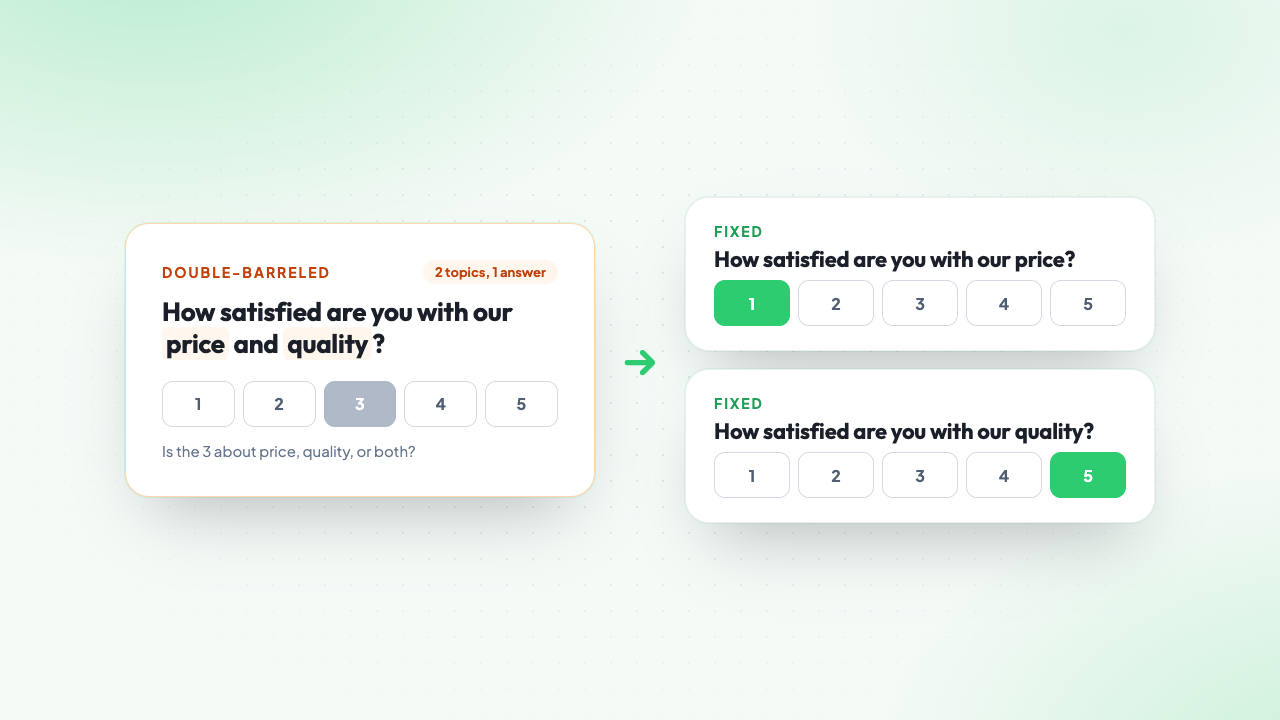
A double-barreled question asks about two or more separate issues but allows only one answer. "How satisfied are you with our price and quality?" is the classic example. A customer who loves the quality but thinks the price is too high has no honest answer. Whatever they pick, you cannot tell whether it describes the price, the quality, or an average of the two. The term comes from a double-barreled gun, which fires two shots at once.
Why double-barreled questions are a problem
The damage is quiet. The survey still produces neat numbers, so nobody notices that they mean nothing.
- The answer cannot be interpreted: a score of 3 might mean "both are average" or "one is great and one is poor"
- Respondents get frustrated or skip the question when no answer is true for them
- You cannot act on the result, because you do not know which part needs fixing
- Results are not comparable over time, since people may weigh the two parts differently each round
How to spot a double-barreled question
Read each question and ask: could someone answer yes to one part and no to the other? If so, it is double-barreled. These signs help you find them quickly.
- The word "and" joins two nouns, verbs or adjectives: "friendly and helpful"
- The word "or" offers two different things: "email or phone"
- A built-in assumption: "How much did the new dashboard save you time?" assumes it saved time
- A cause and effect: "Did the training improve your skills because it was practical?"
- Answer options that combine two ideas: "Satisfied and will renew"
Customer feedback examples
Each example is followed by a fixed version. Most fixes split one question into two.
- Double: How satisfied are you with our prices and product quality? Fixed: How satisfied are you with our prices? / How satisfied are you with the quality of our products?
- Double: Was the support agent friendly and knowledgeable? Fixed: Was the support agent friendly? / Did the support agent have the knowledge to solve your problem?
- Double: How fast and accurate was your delivery? Fixed: Did your order arrive on time? / Did you receive the items you ordered?
- Double: Would you recommend us and buy from us again? Fixed: How likely are you to recommend us? / How likely are you to buy from us again?
- Double: How easy was it to find and buy the product? Fixed: How easy was it to find the product? / How easy was it to complete your purchase?
Product and website examples
Product surveys often bundle features or bundle a feature with a benefit.
- Double: Is the app fast and easy to use? Fixed: How fast is the app? / How easy is the app to use?
- Double: How useful are the reports and integrations? Fixed: Rate each separately: reports, integrations.
- Double: Did the new search help you find products faster and with fewer clicks? Fixed: Did the new search help you find products faster?
- Double: Is our website informative and well designed? Fixed: How informative is our website? / How would you rate the design of our website?
- Double: How much has the mobile app improved your productivity? Fixed: Do you use the mobile app? (Yes / No) Then, if yes: How has it affected your productivity?
Employee survey examples
Employee surveys often pair two qualities of a manager or a job, which hides which one needs work.
- Double: My manager is supportive and gives clear direction. Fixed: My manager is supportive. / My manager gives clear direction.
- Double: I am happy with my salary and benefits. Fixed: I am satisfied with my salary. / I am satisfied with my benefits.
- Double: I have the training and tools I need. Fixed: I have the training I need. / I have the tools I need.
- Double: Do you feel valued and fairly paid? Fixed: I feel valued at work. / I feel I am paid fairly for my work.
- Double: How satisfied are you with your workload and working hours? Fixed: How manageable is your workload? / How satisfied are you with your working hours?
Education and training examples
Course evaluations frequently bundle the instructor with the material, which are very different things to improve.
- Double: The instructor was knowledgeable and engaging. Fixed: The instructor knew the subject well. / The instructor kept my interest.
- Double: Were the course materials clear and up to date? Fixed: The course materials were clear. / The course materials were up to date.
- Double: The workshop was useful and the right length. Fixed: The workshop was useful. / The workshop was the right length.
- Double: Did the homework help you understand and remember the material? Fixed: Did the homework help you understand the material?
- Double: How satisfied are you with the course content and the online platform? Fixed: Ask about the content and the platform in separate questions.
Healthcare, public sector and research examples
In public and academic research, double-barreled questions are especially costly because results are often published or used for policy.
- Double: Do you exercise and eat healthily? Fixed: How many days a week do you exercise? / How would you describe your diet?
- Double: Should the city improve roads and public transport? Fixed: Should the city spend more on roads? / Should the city spend more on public transport?
- Double: Were the reception staff and nurses helpful? Fixed: Were the reception staff helpful? / Were the nurses helpful?
- Double: Do you drink and smoke? Fixed: Do you drink alcohol? / Do you smoke?
- Double: Do you support the new policy because it reduces costs? Fixed: Do you support the new policy? Then: What is the main reason for your answer?
Interview and everyday examples
Double-barreled questions are common in conversation too. In a job interview or a meeting, they let the other person answer only the easier half.
- Double: What are your strengths and weaknesses? Fixed: Ask about strengths, hear the answer, then ask about weaknesses.
- Double: Did you finish the report and send it to the client? Fixed: Did you finish the report? Has it gone to the client?
- Double: Where do you see yourself in five years and how will this job help? Fixed: Ask the two questions one after the other.
- Double: Are you happy with the plan and the budget? Fixed: Are you happy with the plan? / Is the budget enough?
- Double: How was the trip and the hotel? Fixed: How was the trip? How was the hotel?
How to fix a double-barreled question
There are four ways to fix one. The right choice depends on whether you need both answers.
- Split it into two questions, each about one thing. This is the usual fix.
- Keep only the part you need. If you will act only on the price, ask only about the price.
- Use a matrix when you want several attributes rated on the same scale, with one row per attribute.
- Add a screening question for hidden assumptions, such as "Do you use the mobile app?", and show the follow-up only to people who answer yes.
When "and" is fine
Not every "and" makes a question double-barreled. If the two words describe one idea that people experience as a whole, the question is fine. "How satisfied are you with our terms and conditions?" is about one document. "Did you find the pros and cons section useful?" is about one section. The test is the same as before: if a person could reasonably feel differently about each part, split it. If they could not, leave it.
Related question-writing mistakes
Double-barreled questions often appear alongside other wording problems. Check for these at the same time.
- Leading questions suggest the answer: "How much did you enjoy our excellent service?"
- Loaded questions contain an assumption the respondent may not share: "Why do you prefer our product?"
- Double negatives are hard to parse: "Do you disagree that the app is not easy to use?"
- Vague terms such as "regularly" or "recently" mean different things to different people
- Overlapping answer options, such as age ranges 18 to 25 and 25 to 35
A checklist before you send a survey
Run through these questions for every item in your survey. It takes a few minutes and saves a round of unusable data.
- Does this question ask about exactly one thing?
- Could someone agree with one part and disagree with another?
- Does it assume something that may not be true for every respondent?
- Do the answer options each describe one thing?
- Have you read it aloud, or had someone outside the team answer it?
Avoiding double-barreled questions in FormitAI
When you split a set of related questions, a Matrix Choice block keeps the survey compact: put each attribute, such as price, quality and delivery, in its own row and the rating options in shared columns, so each row gets its own answer. For a hidden assumption, add a Yes/No question first and use a rule in the Logic tab to send people who answer no past the follow-up question. If you generate a survey with AI, review each drafted question against the checklist above before you publish, as you would with a draft from a colleague. Then use Preview to answer the survey yourself. Any question you hesitate over is worth a second look.
Frequently asked questions
- What is an example of a double-barreled question?
- "How satisfied are you with our price and quality?" is a common example. It asks about two things, price and quality, but gives only one answer, so someone who likes one and not the other cannot answer accurately.
- How do you fix a double-barreled question?
- Split it into separate questions, each about one thing: "How satisfied are you with our price?" and "How satisfied are you with our quality?" If you only need one of the answers, keep only that part.
- Why are double-barreled questions bad?
- You cannot tell which part of the question the answer refers to, so the data cannot be interpreted or acted on. They also frustrate respondents who have different views on each part.
- Is every question with "and" double-barreled?
- No. If the two words describe one thing that people experience as a whole, such as "terms and conditions", the question is fine. It is double-barreled only when someone could feel differently about each part.
- What is the difference between a double-barreled and a leading question?
- A double-barreled question asks about two things at once. A leading question pushes the respondent toward a particular answer, for example by calling the service "excellent" in the question. A question can be both.
Written by
FormitAI Team
We build FormitAI, an AI form builder that drafts forms from a prompt and asks follow-up questions based on each answer. Our guides come from building and testing forms and surveys every day.
About FormitAIBuild your next form in FormitAI
Describe the form you need and get an editable draft, then let AI follow-ups ask respondents the question you would have asked in person. Free to start.