In this article
- What is an open-ended survey question?
- Open-ended vs closed-ended questions
- Customer feedback examples
- Product feedback examples
- Employee survey examples
- Market research examples
- Event feedback examples
- Education and training examples
- Website and UX examples
- Exit and cancellation examples
- How to write a good open-ended question
- How many open-ended questions should a survey have?
- How to analyze open-ended responses
- Getting the reason without a long survey
- Frequently asked questions
What is an open-ended survey question?
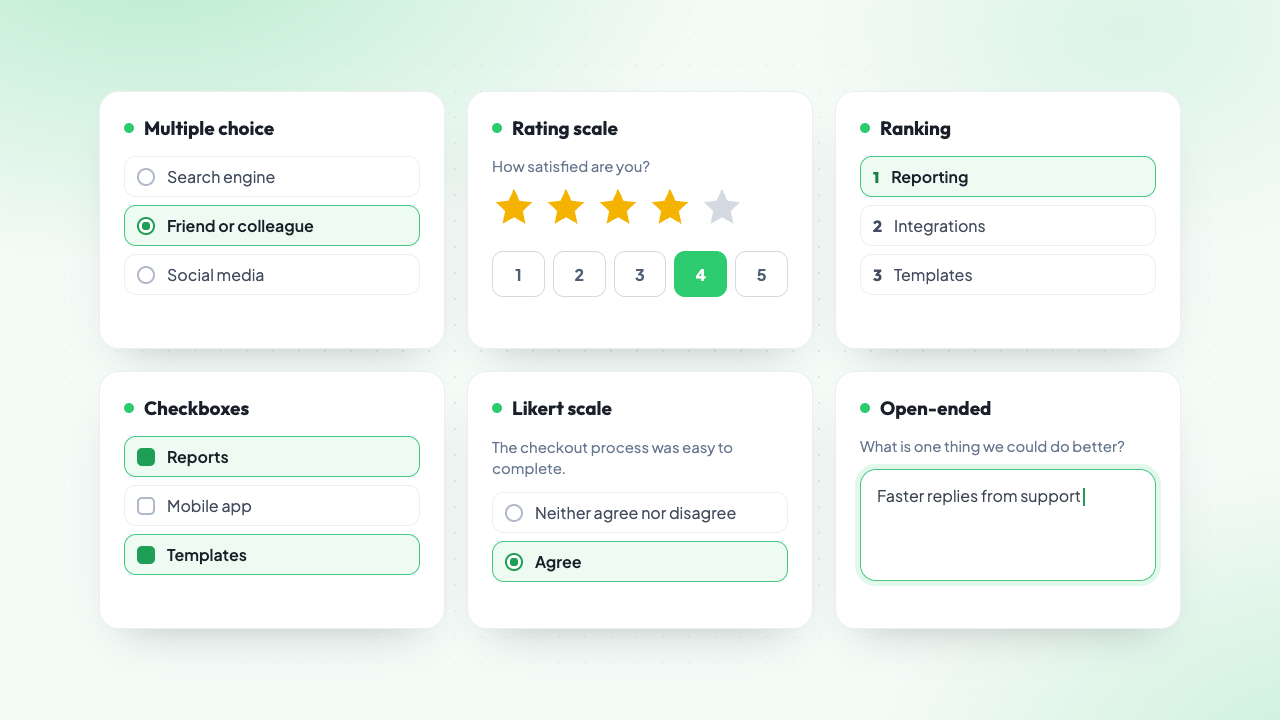
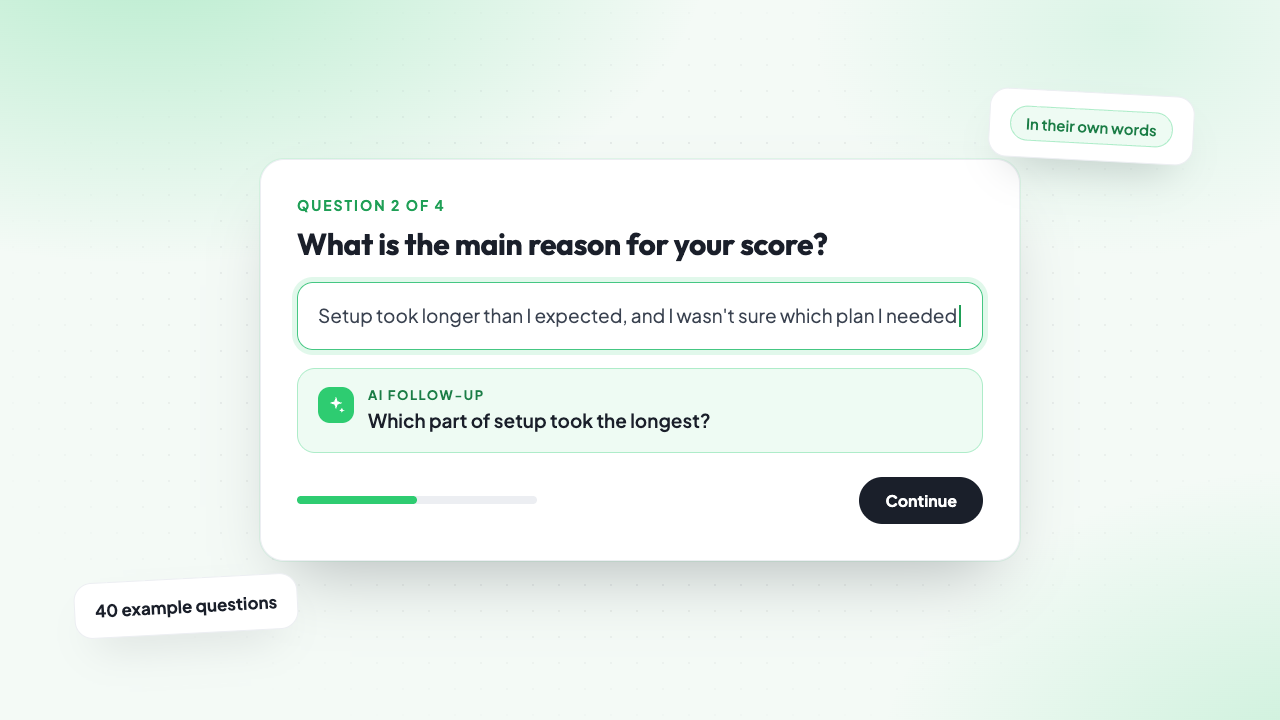
An open-ended survey question is one the respondent answers in their own words, in a text box, instead of picking from a list of options. "What is the main reason for your score?" is open-ended. "How satisfied are you, from 1 to 5?" is closed-ended. Open-ended questions produce qualitative data: reasons, stories, and wording you did not think to offer as an option. Closed-ended questions produce numbers you can count and compare. Most good surveys use a few of each.
Open-ended vs closed-ended questions
Neither type is better. They answer different things. Use a closed-ended question when you already know the possible answers and want to measure how common each one is. Use an open-ended question when you do not know the possible answers yet, or when the reason matters more than the count.
- Closed-ended: fast to answer, easy to chart, but limited to the options you wrote
- Open-ended: slower to answer and to analyze, but surfaces things you did not expect
- Closed-ended tells you how many people are unhappy; open-ended tells you why
- A common pattern is one closed-ended rating followed by one open-ended "why"
Customer feedback examples
Use these after a purchase, a support conversation, or a period of regular use. Each one asks about a single thing, which keeps the answers easy to sort later.
- What is the main reason for the score you just gave?
- What is one thing we could do to improve your experience?
- What nearly stopped you from buying today?
- What problem were you trying to solve when you found us?
- If you could change one thing about our service, what would it be?
Product feedback examples
These work for in-app surveys, beta programs, and feature research. Ask about what people did and what happened, not about what they might do one day.
- What were you trying to do the last time you used the product?
- Which part of the product is the hardest to use, and why?
- What is missing that you expected to find?
- Tell us about the last time the product saved you time.
- What do you use alongside our product to get the job done?
Employee survey examples
Open-ended questions in employee surveys need real anonymity to get honest answers. Say plainly who will read the responses before you ask.
- What is one thing that would make your work easier?
- What do you wish leadership understood about your day-to-day work?
- What is the best part of working on your team?
- What would make you consider leaving?
- What is one thing we should stop doing?
Market research examples
Use these when you are studying a market or testing an idea and do not yet know how people describe the problem. The wording respondents use is often as useful as the content.
- How do you currently handle this task?
- What is the most frustrating part of that process?
- What made you choose the tool you use today?
- What would have to be true for you to switch?
- How would you describe this product to a colleague?
Event feedback examples
Send these within a day or two of the event, while details are fresh.
- What was the most valuable part of the event for you?
- Which session could we have cut, and why?
- What topic do you wish we had covered?
- What would make you more likely to attend next time?
- Is there anything about the venue or schedule we should change?
Education and training examples
For course evaluations and training feedback, ask about what the learner can now do, not only whether they enjoyed it.
- What is one thing you can do now that you could not do before this course?
- Which part of the material was the least clear?
- What would you tell a friend who is thinking of taking this course?
- What slowed down your learning the most?
- What should the instructor keep doing?
Website and UX examples
Short open-ended questions on a site or in an app catch problems analytics cannot explain. Trigger them at a relevant moment, such as after a search with no results or on exit from checkout.
- What were you hoping to find on this page?
- Was anything on this page confusing?
- What stopped you from completing your order today?
- What information is missing from this page?
- How could we make this page more useful?
Exit and cancellation examples
People who are leaving have little reason to soften their answers, which makes cancellation surveys one of the best sources of honest feedback. Keep it to one or two questions.
- What is the main reason you are cancelling?
- What could we have done to keep you as a customer?
- What will you use instead?
- Was there a specific moment when you decided to leave?
- Is there anything else you would like us to know?
How to write a good open-ended question
Most weak open-ended questions fail in one of a few predictable ways. Check each question against this list before you send the survey.
- Ask about one thing. "What did you think of the price and the support?" gets half an answer.
- Start with what, how, or tell us about. Questions starting with did, is, or was invite a yes or no.
- Stay neutral. "What did you love about the event?" assumes they loved it.
- Ask about real past behavior. "What did you do last time?" beats "What would you do?"
- Be specific about scope. "Anything else?" at the end is fine, but it should not be your only question.
How many open-ended questions should a survey have?
Fewer than you want. Typing takes effort, especially on a phone, and each extra text box raises the chance that someone abandons the survey or types "n/a". For a short feedback survey, one to three open-ended questions is a sensible range. Make them optional unless the answer is the whole point of the survey, and place the most important one early, before fatigue sets in. If you are tempted to add a fifth text box, ask whether an interview would serve you better.
How to analyze open-ended responses
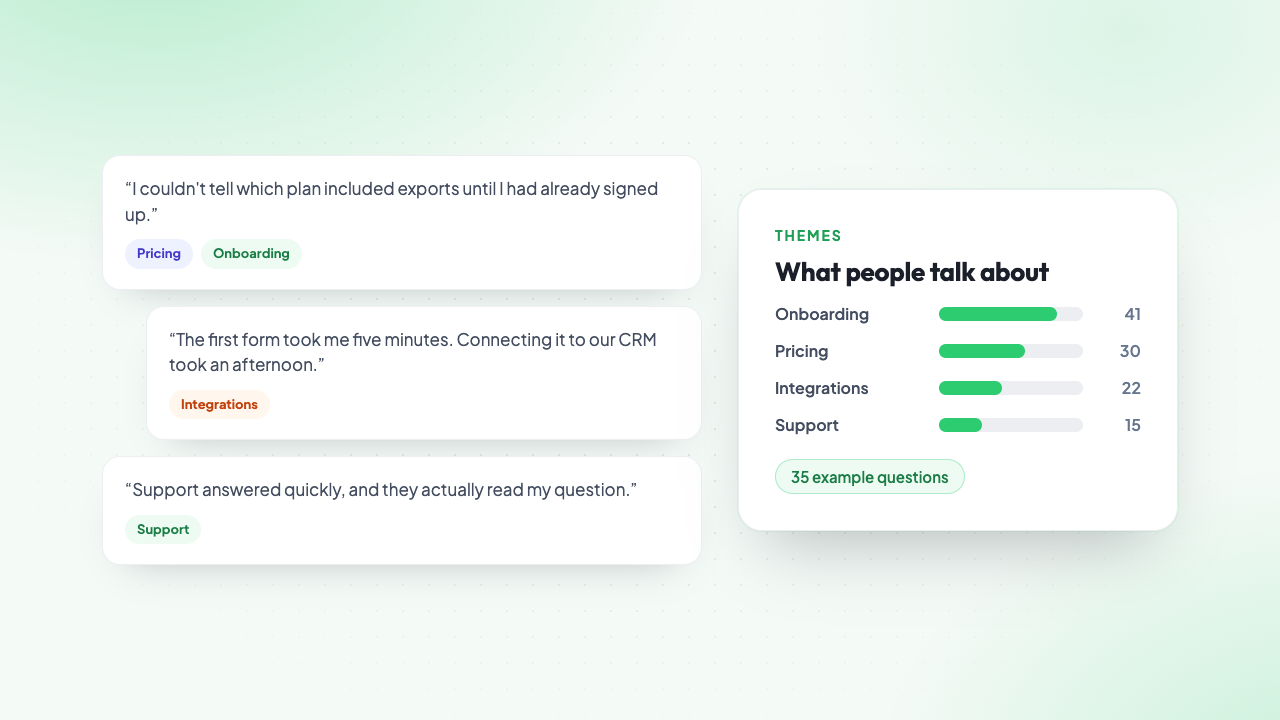
Open-ended answers become useful once you group them. The standard method is called coding: you read the responses, define a small set of themes, and tag each response with the themes it mentions. You can then count how often each theme appears and compare groups.
- Read 30 to 50 responses first, without tagging, to see what comes up
- Write 5 to 10 themes, each with a one-line definition
- Tag every response; one response can carry more than one theme
- Count the themes, then pull two or three direct quotes for each of the largest
- Compare themes across segments, such as detractors against promoters
Getting the reason without a long survey
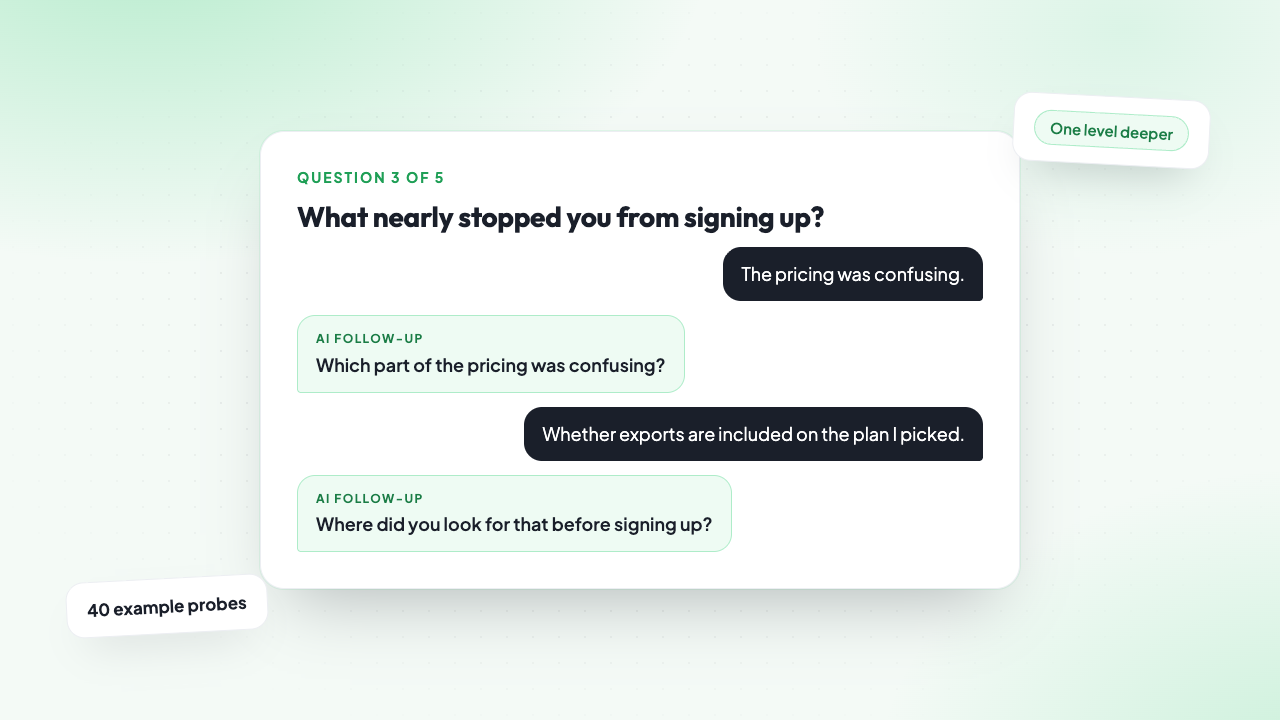
The usual trade-off is that short answers are vague ("too expensive", "confusing") and the only fix is more questions, which lowers completion. FormitAI handles this differently. Add an AI Follow-Up block right after the open-ended question (Add Block, then Other): the form reads the answer while the respondent is still there and asks one relevant probe, such as which part was confusing. You get the detail of an interview follow-up without adding fixed questions for everyone. AI follow-ups work on the Free plan, which includes 20 AI credits a month; each generated follow-up uses one credit.
Frequently asked questions
- What is an example of an open-ended survey question?
- "What is the main reason for your score?" is a common one. The respondent types an answer in their own words instead of choosing from a list. Other examples are "What is one thing we could improve?" and "What nearly stopped you from buying today?"
- What is the difference between open-ended and closed-ended questions?
- A closed-ended question gives a fixed set of answers to choose from, such as yes or no, a 1 to 5 rating, or a list of options. An open-ended question has no options; the respondent writes their own answer. Closed-ended answers are easy to count, and open-ended answers explain the reasons.
- Should open-ended questions be required?
- Usually not. Requiring a typed answer increases drop-off and produces filler such as "n/a". Make them optional unless the survey exists to collect that one answer.
- Are open-ended questions qualitative or quantitative?
- They produce qualitative data. You can turn it into numbers by coding the responses into themes and counting how often each theme appears.
Written by
FormitAI Team
We build FormitAI, an AI form builder that drafts forms from a prompt and asks follow-up questions based on each answer. Our guides come from building and testing forms and surveys every day.
About FormitAIBuild your next form in FormitAI
Describe the form you need and get an editable draft, then let AI follow-ups ask respondents the question you would have asked in person. Free to start.