In this article
- What is a probing question?
- Probing, clarifying and leading questions
- Probes that clarify a vague answer
- Probes that ask for a specific example
- Probes that find the reason
- Probes that measure impact
- Probes for customer feedback surveys
- Probes for user research and discovery interviews
- Probes for job interviews
- Probes for sales and discovery calls
- How to ask a good probing question
- Mistakes that make probes backfire
- Why probing is hard in a survey
- How AI follow-ups ask probing questions in FormitAI
- Writing instructions that produce good probes
- Credits, plans and when the follow-up appears
- How to analyze answers to probing questions
- Frequently asked questions
What is a probing question?
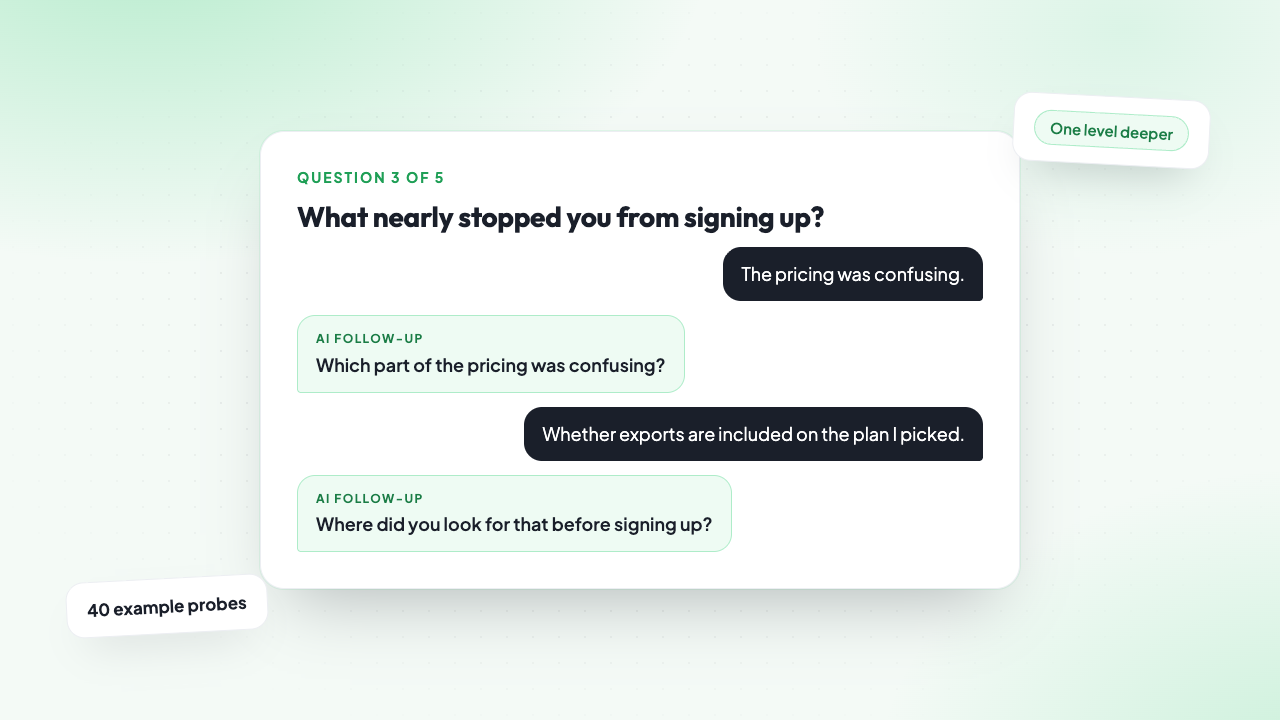
A probing question is a follow-up that builds on something a person has just said. The first question opens a topic; the probe goes deeper into the answer. If a customer writes "the setup was confusing", the probe is "Which part of the setup was confusing?" Probes are the core skill of interviewers, researchers, coaches and good salespeople, because first answers are usually short, general, or polite. The detail you can act on tends to come one question later.
Probing, clarifying and leading questions
These three are often confused. The difference is what the question does with the answer it follows.
- A clarifying question checks meaning: "When you say slow, do you mean the page load or the support reply?"
- A probing question goes further into the answer: "What happened the last time it was slow?"
- A leading question pushes toward an answer: "So the slow support is the main problem, right?" Avoid these.
- Clarifying questions are a kind of probe. Use them first when a word could mean two things.
Probes that clarify a vague answer
Use these when the first answer contains a word that carries a lot of meaning but no detail, such as "confusing", "expensive", "fine" or "better". Repeat the respondent's own word back to them.
- You said it was confusing. Which part was confusing?
- What do you mean by "too expensive"? Expensive compared with what?
- When you say it was fine, what would have made it good?
- Can you say more about what "better" would look like?
- Is that true every time, or only in some situations?
Probes that ask for a specific example
General opinions are easy to give and hard to act on. A concrete recent example tells you what actually happened, and people remember real events more accurately than habits.
- Can you tell me about the last time that happened?
- What were you trying to do at the time?
- Walk me through what you did, step by step.
- What did you see on the screen at that point?
- Who else was involved when that happened?
Probes that find the reason
These move from what happened to why. Phrase them with "what" rather than a bare "why", which can sound like a challenge and make people defend their choice instead of explaining it.
- What made you decide to do it that way?
- What was the most important factor in that choice?
- What would have needed to be different for you to choose otherwise?
- What led up to that?
- What were you expecting to happen instead?
Probes that measure impact
A problem that costs someone five minutes a month and a problem that blocks a sale are not the same. These probes size up how much an issue matters.
- How often does that happen?
- What does it cost you when it goes wrong, in time or money?
- What do you do to work around it today?
- If this were fixed tomorrow, what would change for you?
- How does this compare with the other problems you deal with?
Probes for customer feedback surveys
Most feedback surveys pair a score with an open question. These probes follow the open answer, or follow a low score directly, to turn "it was OK" into something a team can fix.
- What is the main thing that stopped you from giving a higher score?
- Which part of your experience does that apply to most?
- What did you expect that did not happen?
- What would we need to change for you to rate us higher next time?
- Was there a moment when you nearly gave up? What happened?
Probes for user research and discovery interviews
In research, the goal is to understand the person's situation before talking about your product. These probes keep the conversation on their world and their words.
- How do you handle that today?
- What is the hardest part of that process?
- What have you already tried to fix it?
- What happened after you tried that?
- Is there anything about this we have not talked about that matters to you?
Probes for job interviews
Interviewers use probes to get past rehearsed answers. They work best after a behavioral question such as "Tell me about a time you handled a difficult client."
- What was your role, specifically, as opposed to the team's?
- What did you do first, and why that first?
- What was the result, and how did you measure it?
- What would you do differently if it happened again?
- What did the other person say when you did that?
Probes for sales and discovery calls
In a sales conversation, probes help you understand the buyer's problem and how decisions get made, instead of pitching too early.
- What prompted you to look at this now?
- What happens if you do nothing for another six months?
- Who else will be part of this decision?
- What would a good outcome look like a year from now?
- What has stopped you from solving this before?
How to ask a good probing question
The examples above work because they follow a few rules. Use these when you write your own.
- Build on their answer. Use the respondent's own words, not your summary of them.
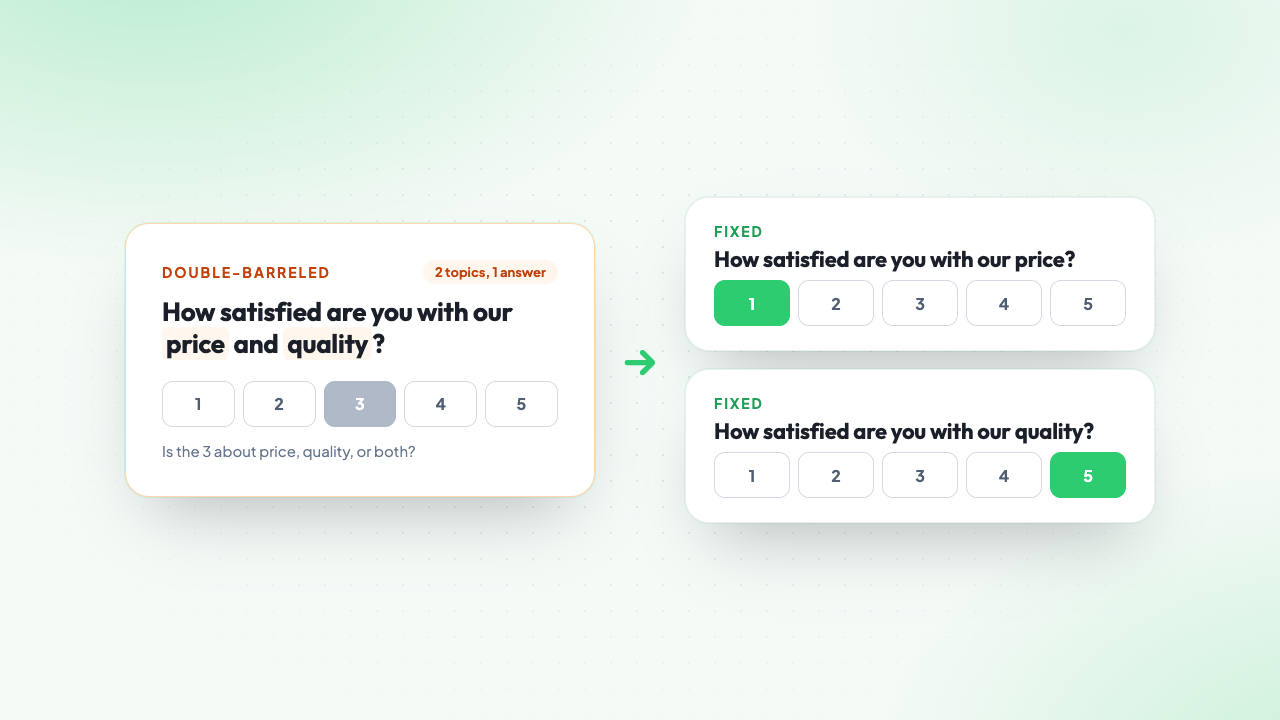
- Ask one thing at a time. "What happened and how did you feel?" gets half an answer.
- Keep it open. Start with what, how, which or tell me, so the answer cannot be yes or no.
- Stay neutral. "What did you think of it?" is a probe; "Wasn't that frustrating?" is a leading question.
- Go one or two levels deep, then move on. Three probes on the same point starts to feel like an interrogation.
- Leave silence in conversations. People often add the most useful detail after a pause.
Mistakes that make probes backfire
A badly asked probe can make the respondent defensive or give you an answer they think you want.
- Asking "why" repeatedly, which sounds like you doubt the answer
- Offering your own explanation for them to agree with
- Probing every answer, which makes the conversation or survey feel endless
- Asking about hypothetical future behavior ("Would you use it?") instead of real past events
- Probing a sensitive topic before the person has had a chance to decide how much to share
Why probing is hard in a survey
In an interview, the interviewer hears a vague answer and asks a probe on the spot. A survey has no interviewer. Every respondent sees the same fixed questions, so a short answer like "pricing" stays a short answer. The usual workaround is to add more fixed questions for everyone, which makes the survey longer and lowers completion. The other workaround is to email people afterwards, by which time most of them will not reply. Neither gets you the detail at the moment the person is thinking about it.
How AI follow-ups ask probing questions in FormitAI
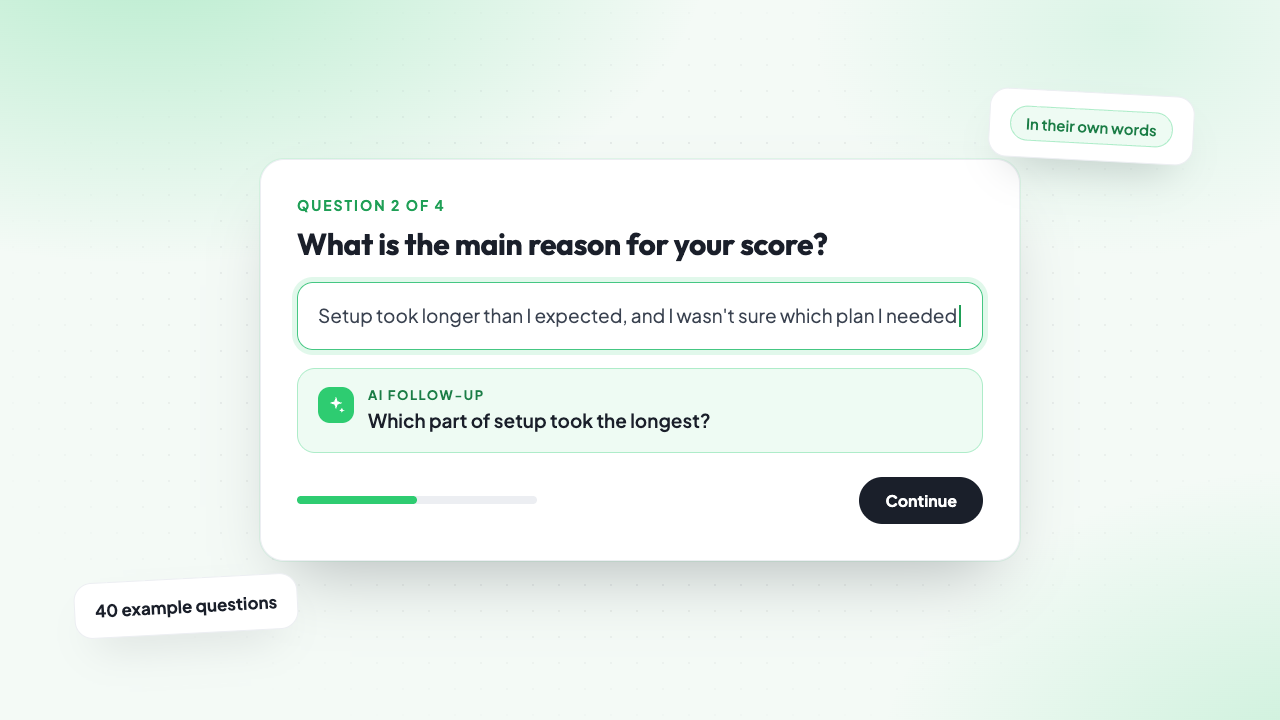
FormitAI has an AI Follow-Up block that asks a probe inside the form. You place it after the question it should follow. When the respondent reaches it, the AI reads the earlier answer and writes a follow-up question based on it, such as asking which part of setup was confusing. The respondent answers it like any other question, and the answer is saved with the rest of the submission in Results. To set it up:
- In the Create tab, select Add Block, open Other and choose AI Follow-Up. Place it after the question it should follow.
- In the Properties panel, under AI Follow-Up Configuration, turn on Enable AI Generation.
- Optionally choose a Trigger Question. The follow-up then appears only after that question is answered. Leave it as Any previous question to use the latest answer.
- Set Maximum Follow-Up Questions to 1, 2, 3 or 5.
- In AI Context & Instructions, tell the AI what to probe for, for example: Ask for a specific recent example of the problem they describe.
- Publish the form and submit a test response to see the follow-up.
Writing instructions that produce good probes
The AI Context & Instructions field is where you apply the rules above. Describe the goal of the probe, not the exact wording, so it fits whatever the respondent wrote. Some instructions that work well:
- Ask which specific part of the product or process their answer refers to.
- Ask for one concrete recent example. Do not suggest an answer.
- Ask what they expected to happen instead.
- Ask how often this happens and what it costs them.
- Keep the question short and neutral, and ask about one thing only.
Credits, plans and when the follow-up appears
AI follow-ups can be published on every plan, including Free. Each generated follow-up uses 1 AI credit from your organization's monthly grant, and the Free plan includes 20 credits a month. If the credits run out, the form keeps working and respondents skip the follow-up. To spend credits only where a probe is most useful, use conditional logic. In the Logic tab, select your score question and add a rule with one condition per low score (answer is 1, answer is 2, and so on), set to match any of them, and send those respondents to the AI Follow-Up block. Point When no rule matches at the question after the follow-up, so everyone else skips it. Set Maximum Follow-Up Questions to 1 or 2 for most surveys; one well-aimed probe usually gets the detail you need.
How to analyze answers to probing questions
Probe answers are open-ended text, so analyze them the same way you would any qualitative data, but keep them linked to the answer they followed.
- Read each probe answer next to the original answer, since one explains the other
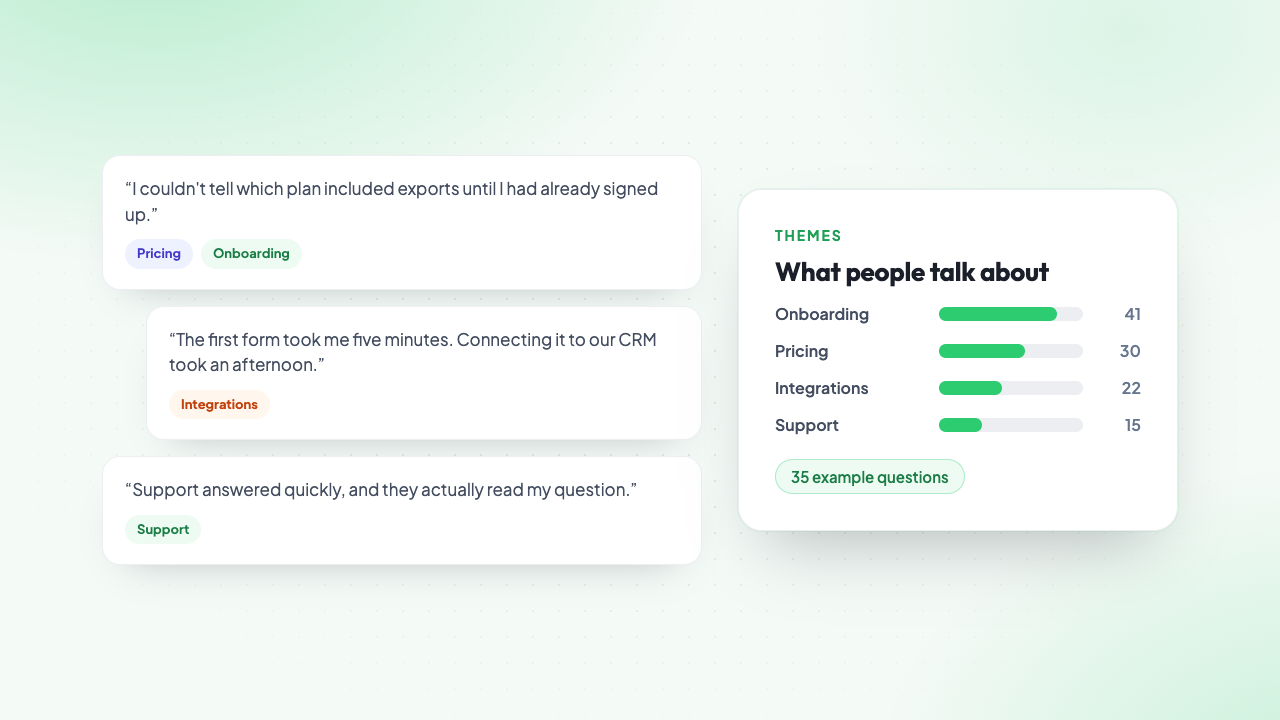
- Tag answers with themes, such as onboarding, pricing or a named feature
- Count how often each theme appears and compare by score group
- Pull two or three direct quotes for each major theme to share with your team
- Look for answers that change your reading of the first one, such as a "pricing" complaint that turns out to be about billing errors
Frequently asked questions
- What is an example of a probing question?
- If someone says a process was confusing, "Which part was confusing?" is a probing question. It builds on their answer and asks for the detail behind it. Other examples are "Can you tell me about the last time that happened?" and "What were you expecting to happen instead?"
- What is the difference between a probing question and a clarifying question?
- A clarifying question checks what someone meant, for example which of two things a word refers to. A probing question goes further and asks for reasons, examples or impact. Clarifying questions are a simple kind of probe and usually come first.
- How many probing questions should you ask?
- One or two on the same point is usually enough. After that, people start to feel questioned rather than heard. In a survey, one probe after a key answer gets most of the value without making the form much longer.
- Can a survey ask probing questions automatically?
- Yes. In FormitAI, an AI Follow-Up block writes a follow-up question based on the respondent's earlier answer while they are filling in the form. You can set it to ask up to 1, 2, 3 or 5 follow-ups, and each generated follow-up uses 1 AI credit.
- Why should you avoid asking "why" in a probing question?
- A bare "why" can sound like you are questioning the person's judgment, which makes them defend their answer instead of explaining it. "What led you to that?" or "What made you choose it?" asks for the same information in a less confrontational way.
Written by
FormitAI Team
We build FormitAI, an AI form builder that drafts forms from a prompt and asks follow-up questions based on each answer. Our guides come from building and testing forms and surveys every day.
About FormitAIBuild your next form in FormitAI
Describe the form you need and get an editable draft, then let AI follow-ups ask respondents the question you would have asked in person. Free to start.