In this article
- What are qualitative survey questions?
- Qualitative vs quantitative survey questions
- Questions to understand motivations
- Questions to explore experiences
- Questions to find pain points
- Questions to test ideas and concepts
- Questions to understand perceptions
- Questions to understand decisions
- Questions to gather suggestions
- How to write qualitative survey questions
- How many responses do you need?
- How to analyze qualitative survey data
- The limits of qualitative survey questions
- Adding a follow-up probe to a survey
- Frequently asked questions
What are qualitative survey questions?
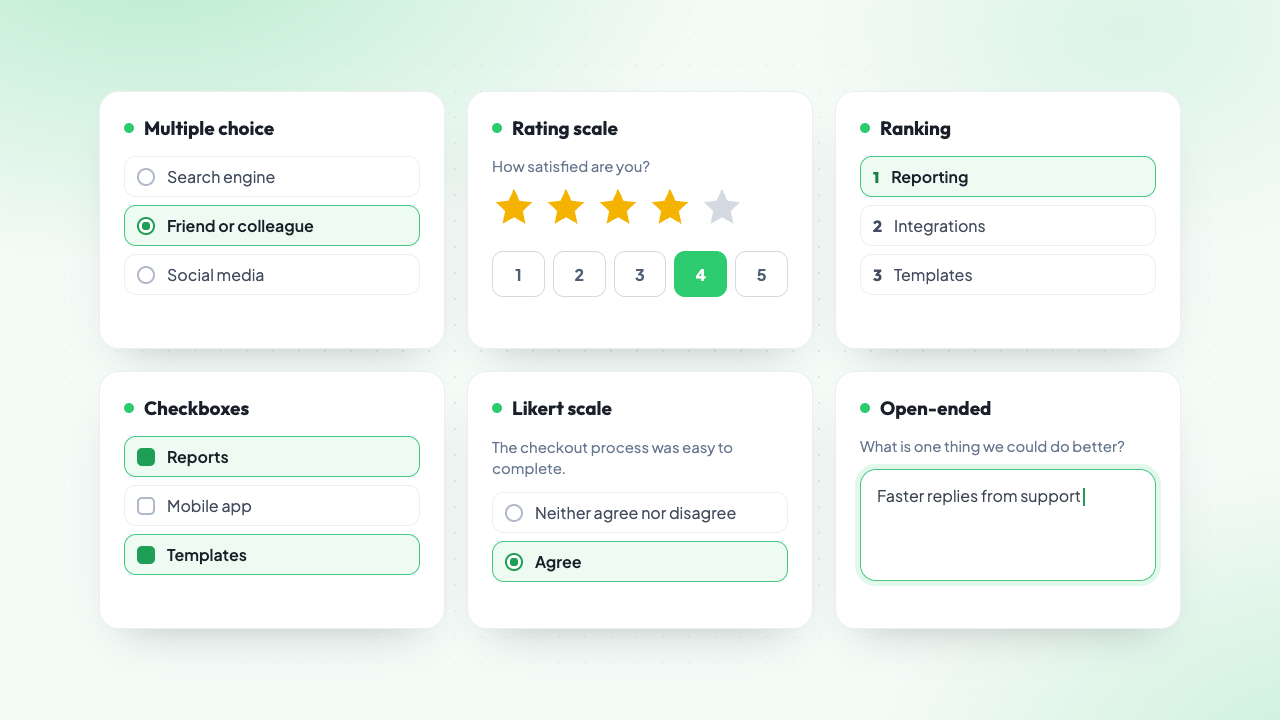
Qualitative survey questions ask for descriptive answers: reasons, experiences, opinions, and stories, written in the respondent's own words. They explore why and how. Quantitative questions measure how many and how much, using ratings and fixed choices. A qualitative question is nearly always open-ended, but the term describes the purpose of the question (understanding) more than its format.
Qualitative vs quantitative survey questions
The two kinds work together. Quantitative questions tell you what is happening and how widespread it is. Qualitative questions tell you why it is happening and what to do about it.
- Quantitative: "How satisfied are you with onboarding, from 1 to 5?" gives a score you can track
- Qualitative: "What was the hardest part of getting started?" gives a reason you can act on
- Quantitative data needs a large sample to be reliable; qualitative data is useful from far fewer responses
- Run qualitative questions first when you do not yet know which options to offer in a quantitative survey
Questions to understand motivations
Use these to learn why people came to you and what they wanted to achieve. The answers shape your messaging as much as your product.
- What were you hoping to achieve when you signed up?
- What was going on in your work or life that made you look for a solution?
- What made you choose us over the alternatives?
- What would success look like for you six months from now?
- What almost made you decide not to go ahead?
Questions to explore experiences
Ask people to describe a specific, recent occasion. Memories of a real event are more accurate than general impressions.
- Tell us about the last time you used the product. What were you doing?
- Describe your first week with us. What stood out?
- Walk us through how you completed your most recent order.
- What surprised you, in a good or bad way?
- How did you feel when you first saw the results?
Questions to find pain points
These uncover problems you can fix. Asking what people do to work around a problem often reveals more than asking about the problem directly.
- What is the most frustrating part of this process for you?
- Where do you get stuck most often?
- What takes longer than you think it should?
- What do you do to work around that problem today?
- What is the cost to you when this goes wrong?
Questions to test ideas and concepts
Use these after showing a concept, a prototype, or a description. Ask for understanding before asking for opinion.
- In your own words, what do you think this product does?
- What is your first reaction to this idea?
- What would stop you from using this?
- Who do you think this is for?
- What would you expect to pay for this, and why?
Questions to understand perceptions
These reveal how people see your brand or product, in their language. The exact words respondents use are worth keeping.
- What three words would you use to describe us?
- How would you explain what we do to a friend?
- How are we different from other options you have tried?
- What do you think we do better than anyone else?
- What do you think we get wrong?
Questions to understand decisions
Use these to map how a purchase or a change of supplier actually happens.
- How did you first realize you needed something like this?
- What other options did you consider?
- Who else was involved in the decision?
- What information did you need before you could decide?
- What nearly changed your mind?
Questions to gather suggestions
Finish with one or two forward-looking questions. Treat the answers as clues about unmet needs, not as a list of features to build.
- If you could change one thing, what would it be?
- What is one thing we should stop doing?
- What do you wish our product could do that it does not do today?
- What would make you recommend us more often?
- Is there anything we did not ask about that you want to tell us?
How to write qualitative survey questions
Good qualitative questions are open, neutral, and anchored in real experience.
- Begin with what, how, or describe, not did or is, so the answer cannot be a single word
- Use "why" with care. "What led you to choose that?" feels less like a challenge than "Why did you choose that?"
- Ask about a specific past event instead of a general habit or a future intention
- Ask about one topic per question
- Remove words that suggest an answer, such as "easy", "great", or "problem", unless the respondent used them first
How many responses do you need?
Qualitative research looks for the range of answers, not a statistically exact proportion. A practical rule is to keep reading responses until new ones stop adding new themes, a point researchers call saturation. For a focused question put to a similar group of people, a few dozen thoughtful responses often gets you there. If your audience is varied, aim for that many per segment. More responses mainly add confidence about how common each theme is.
How to analyze qualitative survey data
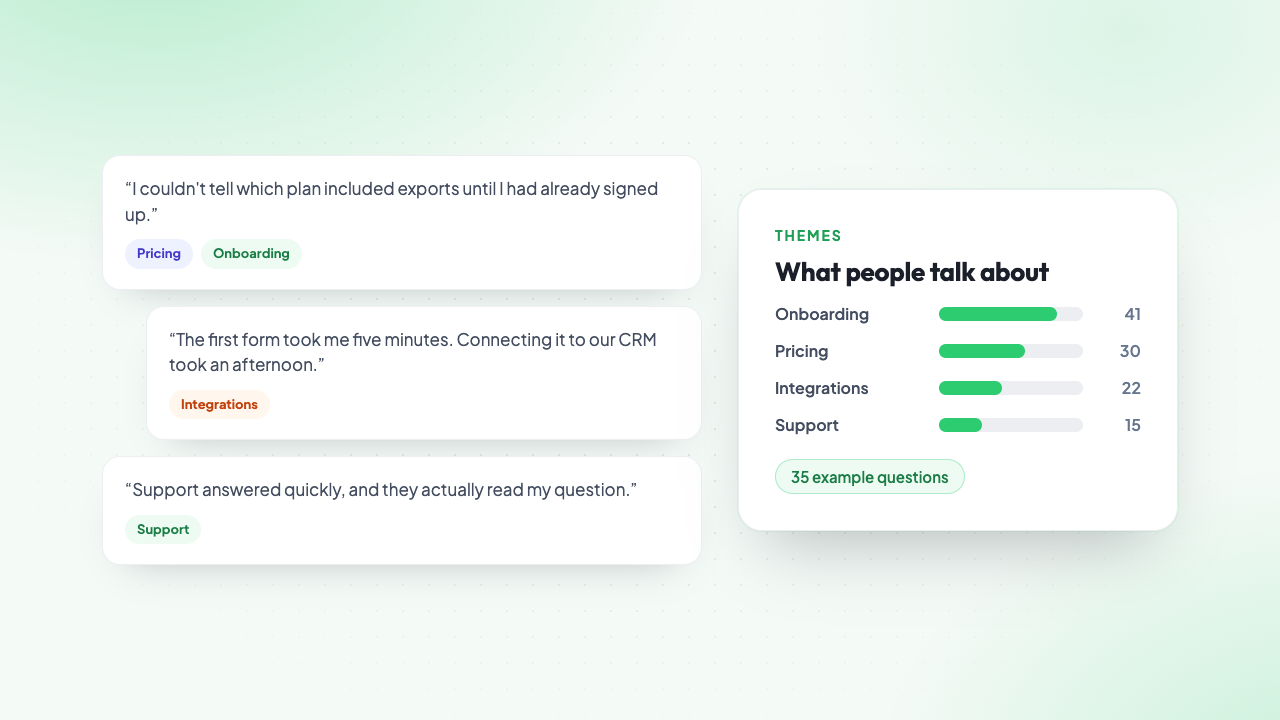
The usual approach is thematic analysis: grouping answers by the ideas they contain.
- Read through a sample of responses to become familiar with them
- Create a short list of themes, with a clear definition for each
- Tag each response with one or more themes
- Count how often each theme appears, and note which segments mention it
- Choose direct quotes that illustrate each major theme
- Write up what each theme means for a decision you need to make
The limits of qualitative survey questions
A survey is not an interview. Written answers are shorter than spoken ones, you cannot ask what someone meant, and people who dislike typing will skip the question. Results describe the people who chose to answer and should not be reported as percentages of your whole customer base without a quantitative check. Use qualitative surveys to find and understand issues, then measure the important ones with closed questions.
Adding a follow-up probe to a survey
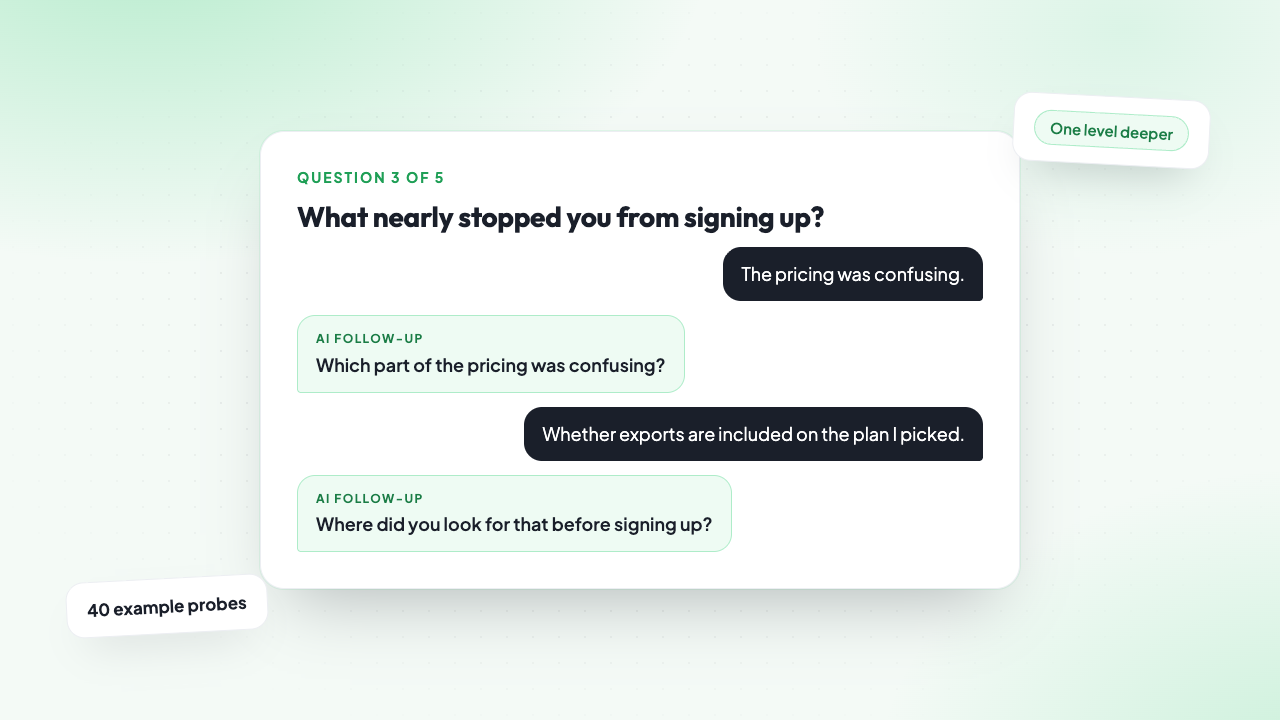
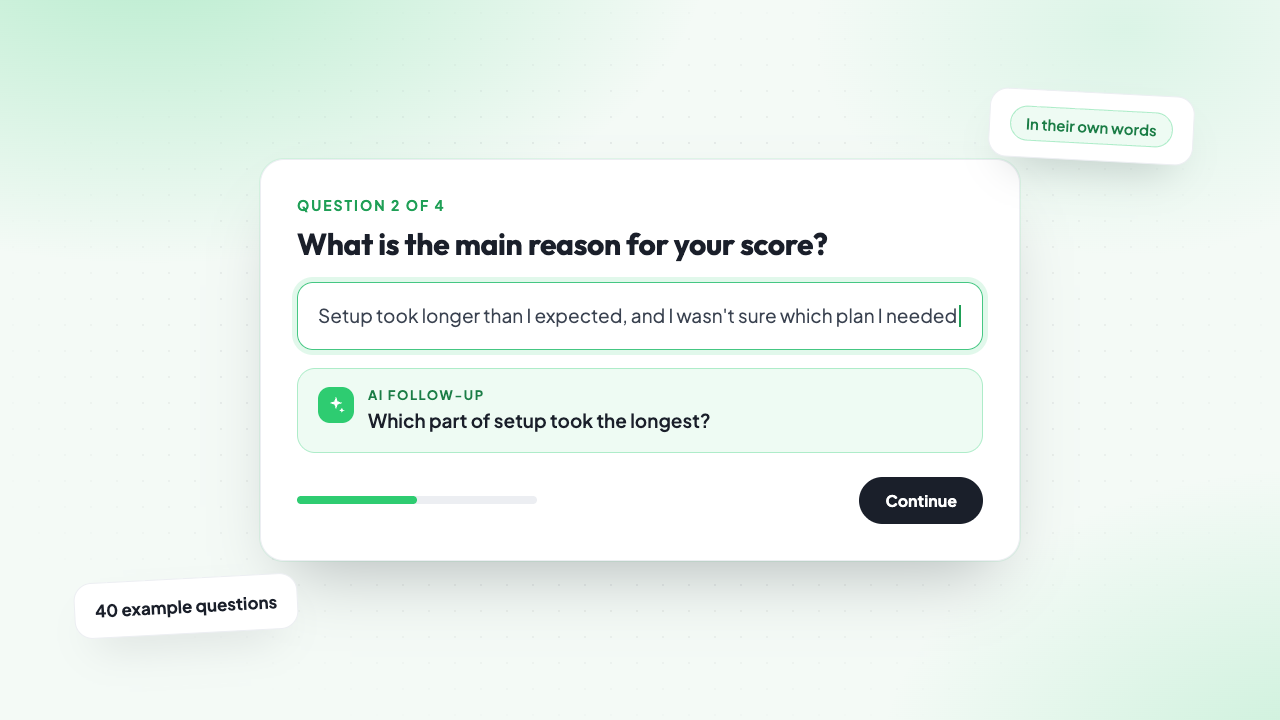
The main thing an interviewer does that a survey cannot is ask a follow-up: "You said it was confusing. Which part?" FormitAI closes some of that gap. Add a Long Text block for your qualitative question and put an AI Follow-Up block after it (Add Block, then Other). The form reads the answer during the session and asks one contextual probe before the respondent moves on, so short or vague answers get clarified at the moment they are given. AI follow-ups work on the Free plan, which includes 20 AI credits a month; each generated follow-up uses one credit.
Frequently asked questions
- What is an example of a qualitative survey question?
- "What was the hardest part of getting started?" is a qualitative question. It asks for a description in the respondent's own words and aims to explain a reason, not to produce a number.
- Are qualitative questions the same as open-ended questions?
- Nearly. Open-ended describes the format: a free-text answer. Qualitative describes the purpose: understanding reasons and experiences. Almost all qualitative survey questions are open-ended.
- Can a survey be both qualitative and quantitative?
- Yes, and most useful surveys are. A common design pairs a rating question with an open-ended question asking for the reason, which gives you a score to track and an explanation for it.
- How do you analyze qualitative survey responses?
- Read the responses, define a small set of themes, tag each response with the themes it mentions, and count the themes. Then pick quotes that illustrate the largest themes and compare them across groups of respondents.
Written by
FormitAI Team
We build FormitAI, an AI form builder that drafts forms from a prompt and asks follow-up questions based on each answer. Our guides come from building and testing forms and surveys every day.
About FormitAIBuild your next form in FormitAI
Describe the form you need and get an editable draft, then let AI follow-ups ask respondents the question you would have asked in person. Free to start.