In this article
- What is a ranking survey question?
- Ranking vs rating questions
- Product and feature prioritization examples
- Customer and market research examples
- Employee survey examples
- Event planning examples
- Education examples
- When to use a ranking question
- When not to use a ranking question
- How to write a ranking question
- How to analyze ranking question results
- A worked example of scoring
- Ranking questions in FormitAI
- Frequently asked questions
What is a ranking survey question?
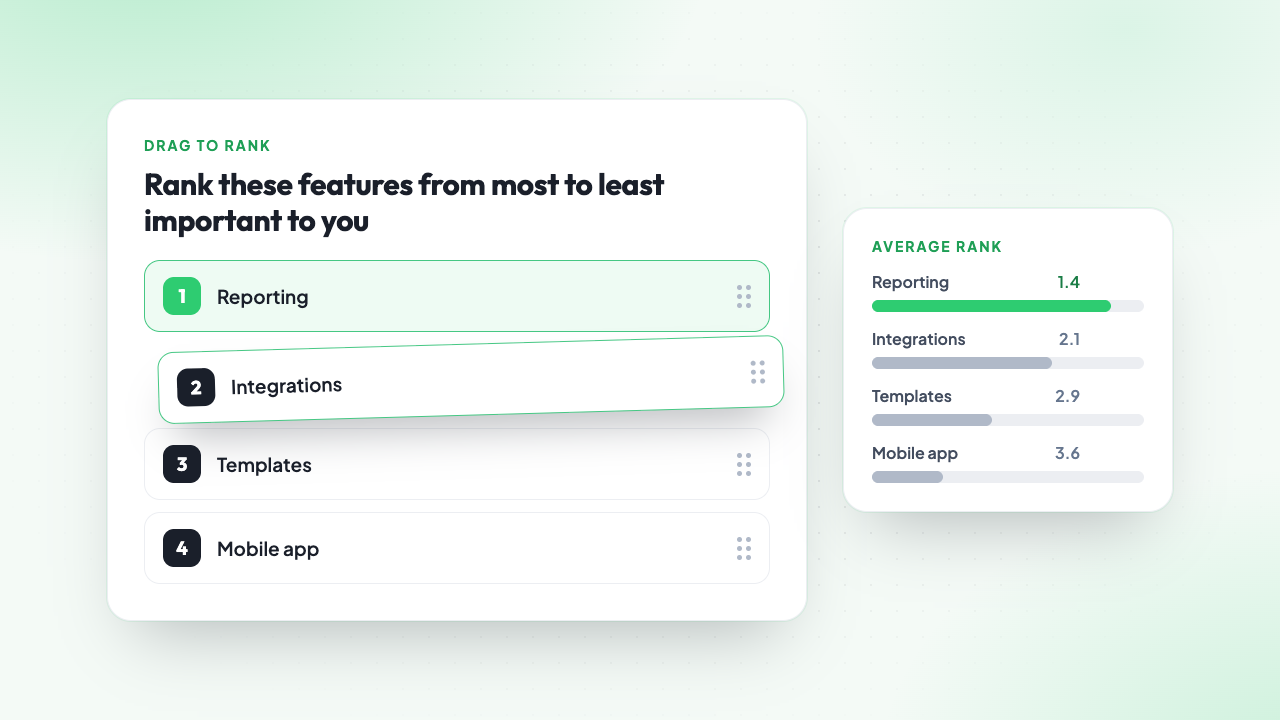
A ranking survey question gives respondents a list of options and asks them to put the options in order, usually from most to least important or preferred. Each option gets a unique position: only one item can be first. The result tells you the relative priority of the options, which a rating question cannot do when people score everything highly.
Ranking vs rating questions
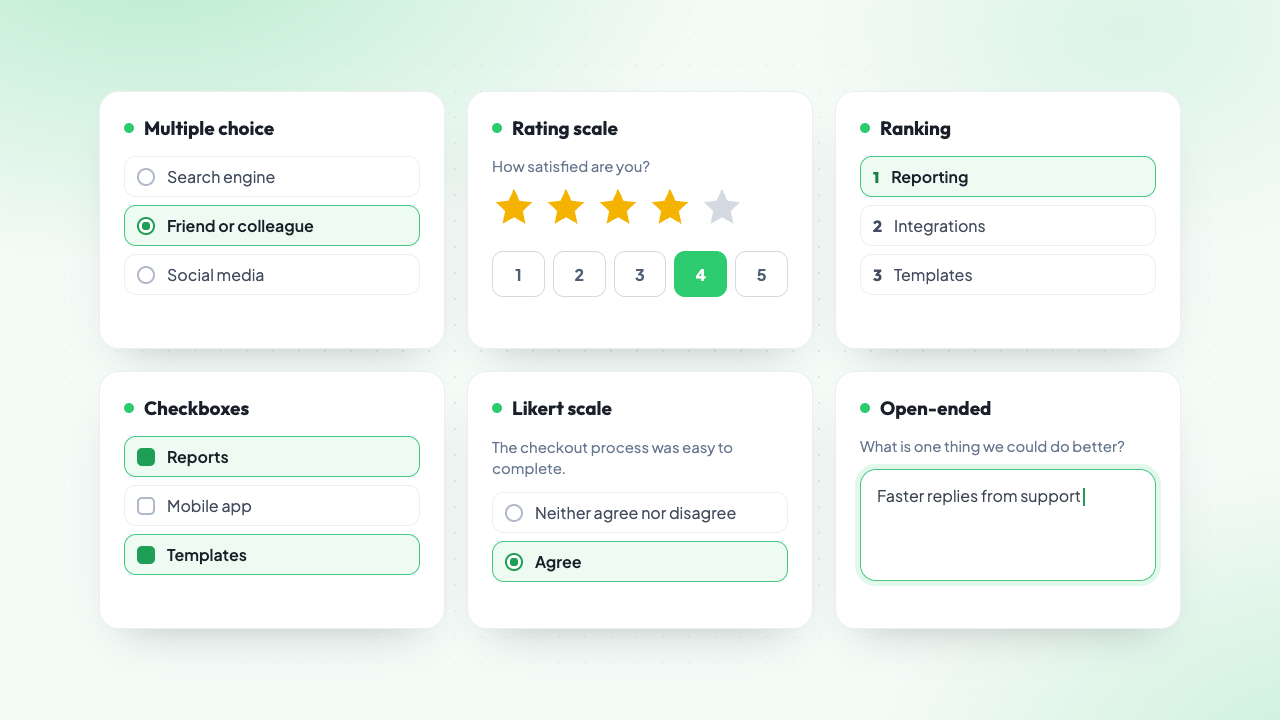
A rating question scores each item on its own. A ranking question compares the items against each other. If you ask people to rate five features from 1 to 5, many will give every feature a 4 or 5 and you learn little. If you ask them to rank the same five, they have to choose.
- Use rating when you want an absolute score for each item, or when items do not compete
- Use ranking when you have limited resources and need to know what comes first
- Rating allows ties; ranking does not
- Ranking tells you the order but not the size of the gap between first and second place
Product and feature prioritization examples
These help product teams decide what to build next. List real, specific options instead of broad themes.
- Rank these features from most to least important to you: reporting, integrations, templates, mobile app, team permissions.
- Rank these planned improvements by which we should build first: faster loading, dark mode, offline access, bulk editing.
- Put these problems in order from most to least frustrating: slow search, confusing menus, missing exports, login issues.
- Rank these integrations by how useful they would be to your team: Slack, Google Sheets, Salesforce, HubSpot, Zapier.
- Rank these pricing factors from most to least important: monthly cost, number of users, storage, support level.
Customer and market research examples
Use these to learn what drives a purchase decision in your market.
- Rank these factors by how much they influence your choice of brand: price, quality, reviews, delivery speed, customer service.
- Rank these stores by how often you shop at them, from most to least often.
- Put these product benefits in order of importance to you: durability, design, ease of use, warranty.
- Rank these sources by how much you trust them for product advice: friends, online reviews, experts, advertising, social media.
- Rank these delivery options from most to least preferred: next-day paid, three-day free, store pickup, locker pickup.
Employee survey examples
Ranking is useful in employee surveys because benefits and improvements compete for the same budget.
- Rank these benefits from most to least valuable to you: health cover, flexible hours, remote work, training budget, extra leave.
- Rank these factors by how much they affect your job satisfaction: pay, manager, workload, career growth, team.
- Put these training topics in order of interest: leadership, technical skills, communication, project management.
- Rank these office improvements by priority: quieter spaces, better equipment, more meeting rooms, better food options.
- Rank these recognition options from most to least meaningful: bonus, public praise, extra time off, a note from leadership.
Event planning examples
Ask these before an event to shape the agenda, or after it to plan the next one.
- Rank these session topics from most to least interesting to you.
- Rank these event formats by preference: in-person, virtual, hybrid.
- Put these days in order of which suit you best: Tuesday, Wednesday, Thursday, Saturday.
- Rank these parts of the event by value to you: keynotes, workshops, networking, exhibitor hall.
- Rank these cities by where you would most like the next event to be held.
Education examples
These suit course planning and student or parent feedback.
- Rank these learning formats from most to least helpful: lectures, group work, practical exercises, recorded videos, reading.
- Rank these course topics by how much time you would like us to spend on them.
- Put these support services in order of importance to you: tutoring, careers advice, counselling, library access.
- Rank these assessment types by preference: exams, essays, presentations, group projects.
- Rank these after-school activities by which your child would most like to join.
When to use a ranking question
Ranking works best under specific conditions. If these do not hold, a rating or multiple choice question is usually the better choice.
- The options compete with each other for time, money, or attention
- The list is short, about five to seven items at most
- Respondents know enough about every option to compare them
- You need an order, not a score for each item
When not to use a ranking question
Ranking asks more of the respondent than most question types. Each added option means more comparisons, and on a phone long drag-and-drop lists are awkward. Avoid ranking in these situations.
- The list has more than about seven options; ask people to pick their top three instead
- Some options will be unfamiliar to some respondents, who will then rank them at random
- Two options could honestly tie, since ranking forces a false difference
- You need to know how strongly people feel, not only the order
How to write a ranking question
Small wording choices make a large difference to the quality of ranking data.
- State the direction: say whether 1 is the most or the least important
- Name the criterion: "most important to you when choosing a supplier" is clearer than "best"
- Keep options parallel and distinct, so no two items mean nearly the same thing
- Randomize the starting order if your tool allows it, because people favor the items shown first
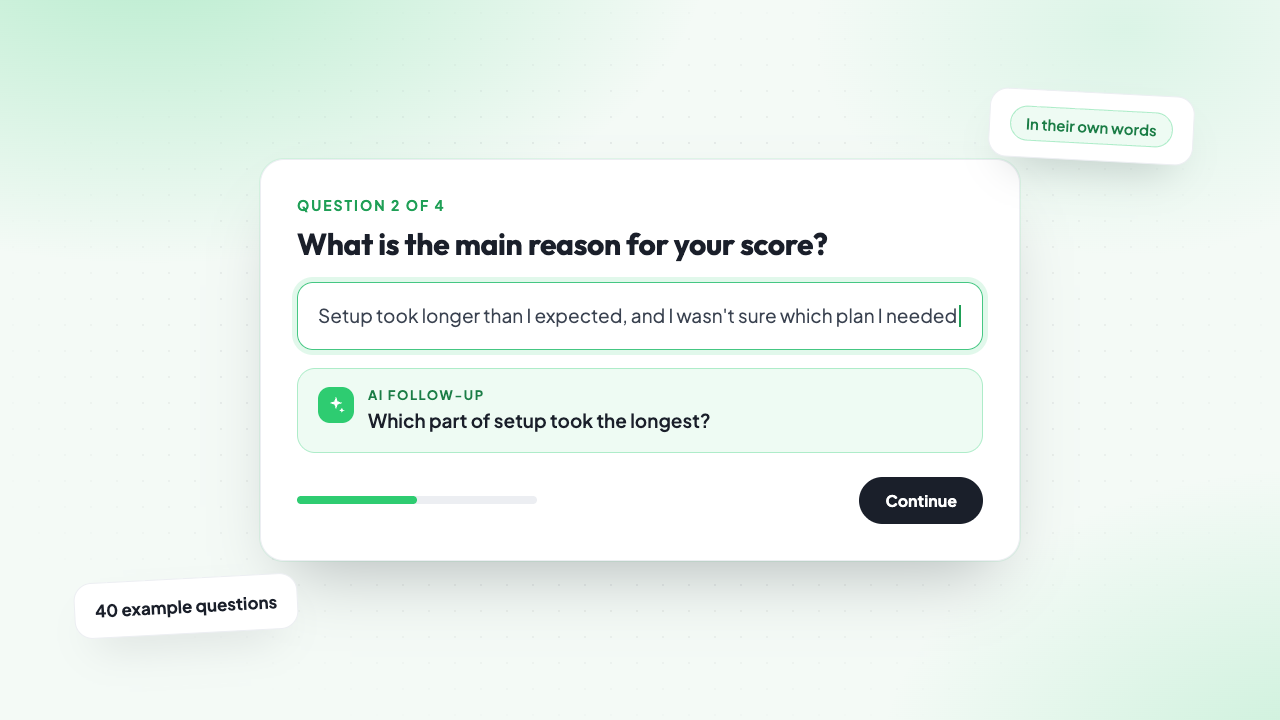
- Follow up with an open-ended question asking why the first choice came first
How to analyze ranking question results
There are three common ways to turn rankings into a result. Using more than one gives a fuller picture.
- Average rank: add up the positions each option received and divide by the number of respondents. The lowest average is the top priority.
- Weighted score: with five options, give 5 points for each first place, 4 for second, down to 1 for fifth, then total the points. The highest total wins.
- First-place share: the percentage of respondents who put each option first. This shows which options have strong supporters.
- Compare segments: an option that is mid-table overall may be first for your largest customers.
A worked example of scoring
Three people rank three options. Person one ranks them A, B, C. Person two ranks them A, C, B. Person three ranks them B, A, C. Option A has ranks 1, 1, and 2, an average of 1.33. Option B has ranks 2, 3, and 1, an average of 2.0. Option C has ranks 3, 2, and 3, an average of 2.67. A is the top priority. With weighted scoring (3 points for first, 2 for second, 1 for third), A scores 8, B scores 6, and C scores 4, which gives the same order.
Ranking questions in FormitAI
In the FormitAI builder, add a Ranked Option block and enter the choices you want ordered. Respondents arrange them by priority, and the ordered answer is stored with the submission. Keep the list short, say in the question whether the first position means most important, and consider adding a Long Text question after it to capture the reason for the top choice. If you only need people to pick items without ordering them, use a Multi-Select block instead.
Frequently asked questions
- What is an example of a ranking question?
- "Rank these features from most to least important to you: reporting, integrations, templates, mobile app, team permissions." The respondent puts all five in order, and each position can be used only once.
- What is the difference between ranking and rating questions?
- A rating question scores each item separately, so several items can get the same score. A ranking question makes the respondent order the items against each other, so there are no ties.
- How many options should a ranking question have?
- About five to seven at most. Longer lists are tiring to order and the middle positions become unreliable. If you have more options, ask respondents to choose their top three.
- How do you calculate the result of a ranking question?
- The simplest method is the average rank: add the positions each option received and divide by the number of respondents. The option with the lowest average is the highest priority. You can also use a weighted score or the share of first-place votes.
- Is ranking data ordinal?
- Yes. Ranking produces ordinal data: it shows the order of the options but not the distance between them. Second place may be almost tied with first or far behind it.
Written by
FormitAI Team
We build FormitAI, an AI form builder that drafts forms from a prompt and asks follow-up questions based on each answer. Our guides come from building and testing forms and surveys every day.
About FormitAIBuild your next form in FormitAI
Describe the form you need and get an editable draft, then let AI follow-ups ask respondents the question you would have asked in person. Free to start.